

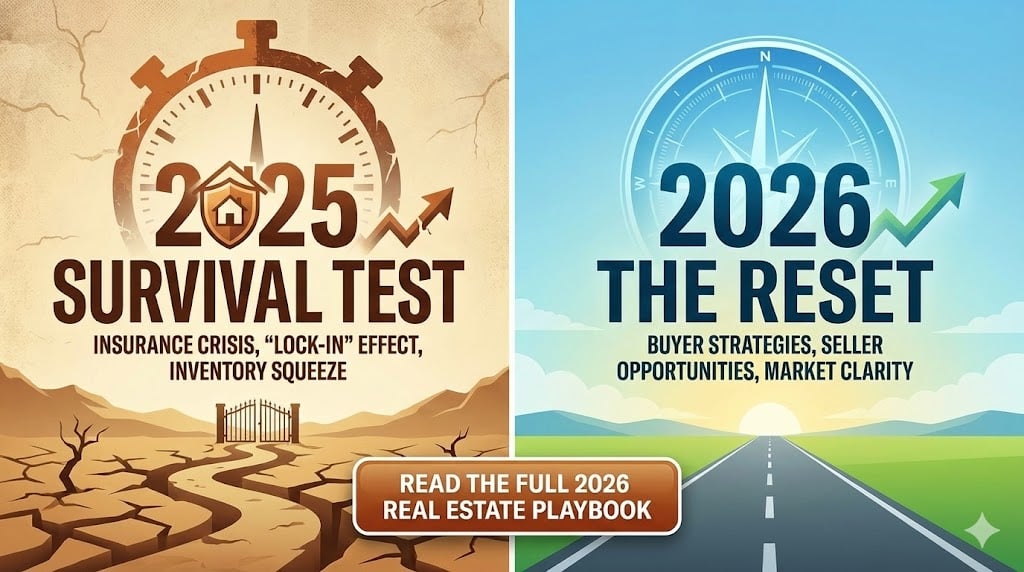
If you followed the news in 2025, you probably thought the housing market was about to collapse.
We had everything thrown at us: massive wildfires in Los Angeles, sky-high interest rates, intense tariff wars driving up costs, conflicts overseas, and even the federal government shutting down at the end of the year. In a normal world, that combination usually causes the economy to tank.
But a weird thing happened in Southern California: The market survived.
In fact, home prices didn’t just survive; they actually went up a little bit. If you’re wondering how that is even possible—and what you should do with your money in 2026—you’ve come to the right place. Let’s break down the year of chaos and look at the road ahead.
The "Lock-In" Effect: Why There Were No Houses to Buy
The biggest reason home prices stayed high in 2025 comes down to one simple concept: The Lock-In Effect.
Imagine you have a monthly subscription to Spotify for $3.00. Suddenly, the price for new users jumps to $7.00. Are you going to cancel your $3.00 plan to sign up for the new expensive one? No way. You’re going to hold onto that cheap plan for dear life.
That is exactly what happened to homeowners.
The Old Days: Most California homeowners (about 79%) have a mortgage rate under 5%. Many are sitting at 3%.
The New Reality: In early 2025, rates spiked over 7%.
If a homeowner sold their house to buy a new one, they would have to trade their "cheap" loan for an expensive one, which could double their monthly payment. So, they just didn’t sell. This created a massive shortage of homes. Even though buying was hard, there were so few houses available that prices stayed high.
The Good News: By the very end of 2025, rates dropped to about 6.15%. That might not sound like a huge difference, but it gave buyers about 10% more purchasing power—helping to thaw out the market as we head into the new year.
The Fire Crisis and the "Uninsurability" Problem
The saddest and hardest part of 2025 was the wildfires in Los Angeles (specifically the Palisades and Eaton fires). These weren’t just burning trees; they burned expensive homes in wealthy neighborhoods.
This created a ripple effect that is arguably scary for the market: The Insurance Crisis.
After the fires, big insurance companies (like State Farm and Allstate) looked at the risk and said, "We’re out." They stopped writing new policies in many areas.
Why this matters: You generally cannot get a mortgage if you cannot get home insurance.
The result: In fire zones, regular families couldn't buy homes because they couldn't get insurance. Instead, wealthy investors stepped in, buying up burned land with cash.
This is making "safety" a luxury item. If you want to live in the hills, you now need deep pockets to handle the insurance costs.
The Report Card: How Your County Did
Not every area performed the same. Here is the snapshot of Southern California right now:
1. Orange County (The Star Student)
Median Price: $1.4 Million
Trend: Up 3.7%
Why: Orange County became the "safe haven." Wealthy buyers moved here from LA to escape the fire risks and the luxury home taxes. It is currently a strong seller's market.
2. Los Angeles County (The Struggle)
Median Price: ~$942,000
Trend: Up 0.6% (Basically flat)
Why: Between the wildfires, insurance issues, and the "Mansion Tax," luxury sales in LA slowed down significantly. However, condos and townhomes are still selling because they are more affordable.
3. Inland Empire (The Affordability Zone)
Median Price: ~$600,000
Trend: Sales Up 10% in San Bernardino
Why: This is the affordability "release valve." People who are priced out of the coast are moving here to find homes under $600k.
The 2026 Forecast: "The Great Housing Reset"
So, is the market going to crash next year?
According to the data, no. We are entering a phase experts are calling "The Great Housing Reset." Think of it as a return to normal rather than a boom or a bust.
Here is what is projected for 2026:
Interest Rates will Stabilize: Experts predict mortgage rates will settle around 6.0%. It’s not the 3% of the pandemic years, but it’s stable.
Prices will creep up: Expect prices to rise slowly—about 3.6%.
More Inventory: As rates drop a little, some of those "locked-in" homeowners might finally decide to move, giving buyers more options.
The Playbook: How to Win in 2026
The market has changed, so your strategy needs to change too. Whether you are buying or selling, "business as usual" won't work anymore.
For Buyers: Get Creative with Financing
We are not expecting interest rates to drop dramatically back to 3% or 4% in the next year or two. Waiting for a miracle crash might leave you renting forever. Instead, you need to be smarter with your loan structure.
The "2-1 Buydown" Strategy: Since rates are hovering around 6%, ask for a "2-1 Buydown." This is where the seller pays to lower your interest rate by 2% for the first year and 1% for the second year. It gives you a lower monthly payment now while you wait for rates to eventually drift down so you can refinance later.
Buy Down the Rate (Points): If you plan to stay in the home for a long time (10+ years), it makes a lot of sense to pay "points" upfront. This is a fee you pay at closing to permanently lower your interest rate. Since the standard rate isn't dropping fast, paying to force it down yourself can save you thousands in the long run.
For Sellers: It’s a Beauty Contest and a Price War
The days of putting a "For Sale" sign in the yard and getting 20 offers are over. Today, you have to fight for attention.
Create Your Own Seller's Market: Even if the market is slow, your house can be the exception. A home that is in pristine condition and priced correctly will still sell fast. You can create a "bidding war" environment just by presenting a better value than your neighbors.
The "Repair" Trap: Buyers are stressed financially. Their interest rates are high, and their insurance costs are skyrocketing. They do not have extra cash to fix a leaky faucet or replace old carpet.
The Reality: Because their cost of owning is so high, buyers will be very demanding during inspections. If your home needs work, buyers will either ask for a huge price reduction or walk away. To win, your home needs to be move-in ready.
Why 2026 Is About Smart Strategy, Not Survival
2025 was a survival test, and the market passed. 2026 won't be easy, but it will be normal. If buyers get creative with their loans and sellers focus on perfection and pricing, there are great deals to be made this year.
Ready to Make the Right Move in 2026?
Whether you’re considering buying, selling, or simply trying to understand where you stand in this “Great Housing Reset,” having the right strategy matters more than ever.
At Jack Ma Real Estate, we don’t believe in guesswork. We help clients navigate changing market conditions with data-driven insights, smart pricing strategies, and creative financing solutions tailored to today’s environment.
If you’re thinking about selling, we can provide a clear, realistic picture of what your home could be worth in 2026. If you’re planning to buy, we’ll help you structure offers and financing strategies that keep you competitive—even with higher interest rates. And if you’re unsure what your next move should be, a brief strategy conversation can help you avoid costly mistakes
Check out this article next