

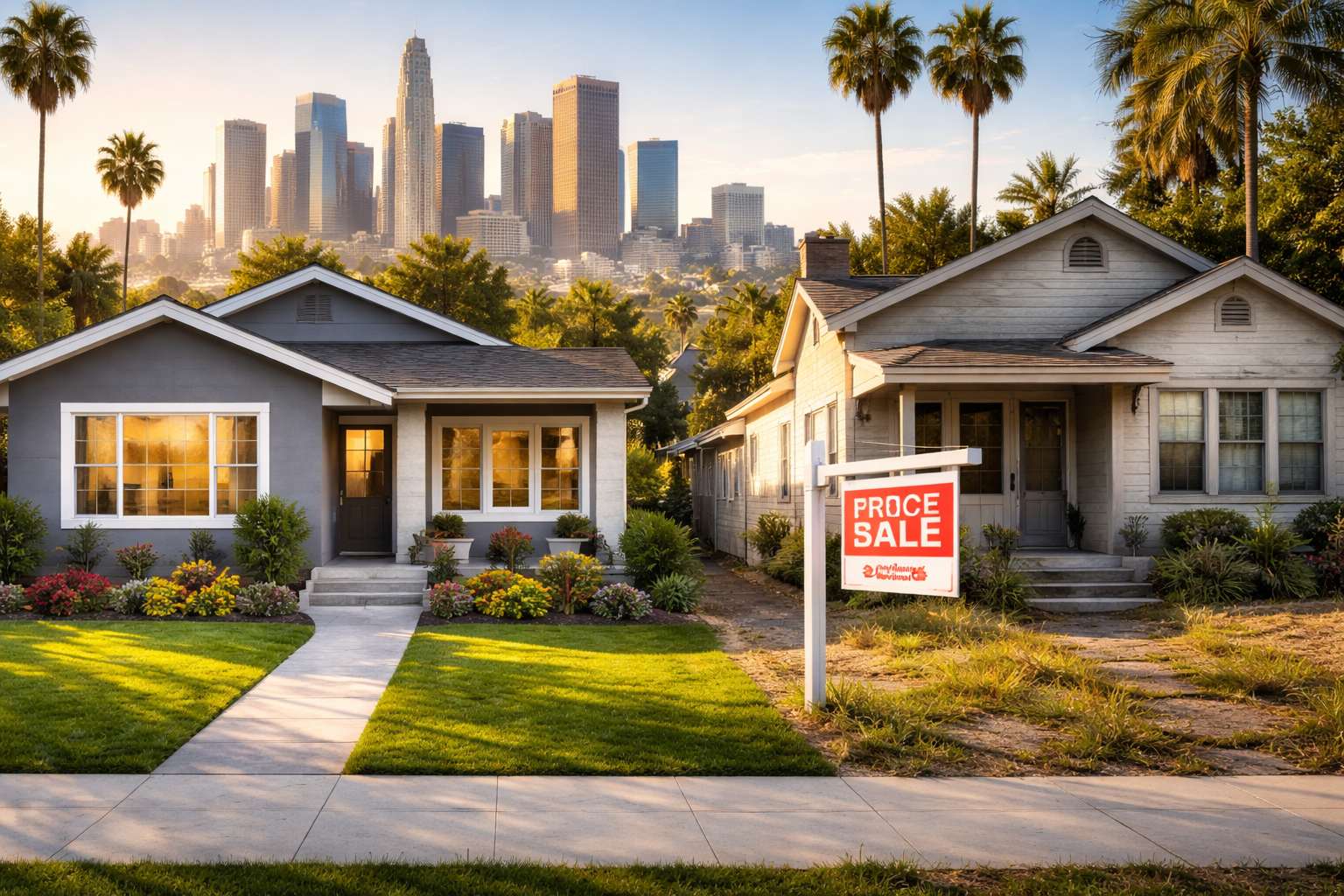
In spring 2026, Southern California’s housing market shows a stark split. “Two-speed housing market” is the term analysts use to describe it: homes that are move-in ready, well-priced and professionally marketed find buyers almost instantly, while those slightly out of line with market expectations can linger on the market for months. In Los Angeles County, for example, the median days on market has been rising. Realtor.com reports that in January 2026 the typical LA home lingered 72 days before sale, up from 70 days a year earlier. By contrast, top-tier “wow” homes often go pending in under three weeks. A local case study in Southern California found that homes under contract in the first 14 days sold for a 3.8% premium over slower sales, while listings older than 60 days sold at a steep discount. This gap creates winners and losers: well-prepared homes cruise to contract, while others require price cuts and patience.
Current Market Context: Spring 2026 Demand and Inventory
The Spring housing market in California is usually the busiest of the year, and 2026 is no exception – but with a twist. After two years of tight inventory, Southern California is seeing an inventory increase. For instance, Orange County’s for-sale supply jumped 30% year-over-year by late 2025, and Los Angeles County listings were up about 13% in January 2026. This higher supply means buyers have more choice, and they are shopping more deliberately. On the demand side, mortgage rates have fallen from recent peaks. By early 2026, 30-year rates averaged around 6.0–6.2% (down from ~7% a year earlier), giving many buyers roughly 10% more purchasing power than in 2025. Some forecasts (like Zillow’s) even project rates dipping into the 5% range by late 2026. Lower rates and more listings have drawn more buyers into the spring market – Redfin notes a 21% jump in buyer demand in early 2026 compared to late 2025 (even as some spring listings hit the market).
Despite more buyers, homes are spending longer on market than during the frenzy of 2020–2021. In LA, median pending times run in the 50–60 day range. For example, Zillow data shows LA-area homes went to pending in about 48 days on average in January 2026. Another local analysis finds Los Angeles County homes averaged 56 days on market as of late 2025 (up from 47 days a year before), with the City of Los Angeles at about 61 days. In Orange County, homes sold after 55 days on average in Dec. 2025, up from 47 days in Dec. 2024. These longer times translate into more listings requiring adjustments: one report found 10.2% of LA listings saw price cuts in January 2026, up 2.9 points from a year earlier.
Overall, Southern California looks to analysts like a normalizing market. Modest price growth (or slight declines) is expected instead of the crazy jumps of the pandemic years. One Los Angeles forecast predicts home values might rise roughly 3–6% in 2026, reflecting steady but unspectacular gains. Orange County’s median price was about $1.2 million in Dec. 2025 (a 2% increase from a year prior), showing only moderate appreciation. In this environment, sellers can no longer count on multiple-bid bidding wars across the board. Instead, buyer leverage is rising: homes priced properly (and updated) still sell well, but many other listings face buyer scrutiny and negotiation.
The “Two-Speed” Phenomenon: Fast vs. Slow Sales
What exactly creates the two speeds? It boils down to a property’s appeal and price. In practice, there are two broad lanes:
- Fast sellers (“14-Day Sprint”) – These homes check all the boxes. They are move-in ready, usually freshly renovated or well-maintained, professionally staged, and priced right at market. They generate buzz immediately and often receive multiple offers. In Los Angeles, such listings are going pending in a median time of around 14 days according to industry insiders. Sellers of these homes often walk away with full price or above. For example, a study of one SoCal market (Chino Hills) showed listings under contract in 0–14 days sold for a median of $1,130,000, compared to $1,089,000 for slower sales. Crucially, a quick sale often means top-dollar: that study concluded that “speed and price aren’t opposing forces” – fast-moving homes tend to command premiums.
- Slow sellers (“2-Month Drag”) – These are homes that are slightly out of sync. They may be overpriced, outdated, need work, poorly staged, or otherwise less competitive. In today’s selective market, such listings quickly lose buzz. Many sit for 60–90 days or longer before attracting a buyer, and by then sellers often must drop the price. The same Chino Hills analysis noted that houses lingering beyond 60 days suffered a “stale inventory” effect, selling at a median price more than 14% below the overall market median. Locally in Los Angeles, agents warn that mispriced homes “typically sit 60+ days”, and often end up accepting 5–10% price reductions to revive interest. In January 2026 LA, about 1 in 10 listings already had a price cut. In sum, slow-moving homes pay a price penalty: the longer they wait, the lower the eventual sale price tends to be.
This split is sometimes described as “two completely different housing markets” operating side by side in Southern California. In practice, every neighborhood sees this effect: a $1.1 million home in one part of town might sell in two weeks, while a similar home across town for the same price might take two or three months if buyers perceive any issues. It’s not that the market is truly bifurcated by geography alone – rather, buyer selectivity creates two speeds even on the same street. One industry analyst puts it bluntly: in 2026 “the market still favors sellers overall – demand outpaces supply – but that advantage is narrowing. If your home is priced right and in good condition, it will sell; if it’s not, you’ll know quickly”.
Why Some Homes Sprint, Others Stall
Pricing: The single biggest factor is price relative to value. Buyers today are informed and cautious. In higher-rate conditions, they won’t chase an overpriced listing. Homes that hit the market just at or slightly below true value spark immediate bidding. Those listed above what buyers expect will generate only cursory interest. In practice, overpriced homes often reveal themselves: after a few weeks with weak showings, sellers need to cut the price to attract buyers. Realtor.com notes that modest price dips in LA (median list price down 1.8% in Jan. 2026) and more frequent price reductions signal a more balanced market. In fact, a Zillow survey found that historically, the first 30 days are critical: if no strong offers appear, a seller likely misread the market.
Home Condition & Updates: “Move-in ready” and “turnkey” are magic words in 2026. Buyers want to avoid extra projects and costs. Homes with new kitchens, updated bathrooms, fresh paint and clean landscaping stand out. By contrast, properties needing renovations or even minor fixes move much slower – buyers either ask for concessions or skip them entirely. In some Los Angeles neighborhoods, even cosmetic issues can stall a sale.
Marketing & Presentation: High-quality photos, virtual tours, and expert staging help a listing pop online. In a crowded spring market, well-marketed homes capture attention right away. According to staging industry data, sellers who prepare (e.g. professional staging, good photography) can sell 15–20 days faster and for 3–5% more than rushed listings. The opposite is true for lackluster marketing: dull photos or poor listing descriptions can bury a home, extending its market time.
Buyer Preferences and Segments: Different segments of the market behave differently. Luxury homes (over $4M) and condos, for example, have seen more price reductions recently as some high-end buyers hesitate. Conversely, well-priced family homes in top school districts (like Santa Monica) are still getting multiple offers. Some areas have “hot” demand (e.g. coastal or tech-linked communities), while others feel the chill. This contributes to the two-speed split: a prime Santa Monica house may sell in days, while a similar one in a less-desirable area languishes.
Seasonality – Spring Surge: The timing of listing a home is crucial. Spring (March–May) is traditionally the strongest selling season in California. In 2026, that held true: buyers who stepped into the market early saw a flood of inventory, but also more competition. Sellers preparing their homes before the spring rush have a big advantage. According to a Los Angeles market analysis, homes listed after strategic 2–3 months of prep in late winter sold 25–40% faster in spring, often with significantly higher proceeds. In short, sellers who rushed to market at the right time (and price) became part of the fast lane; those who listed later or without prep often ended up in the slow lane.
Mortgage Rates and Buyer Power in 2026
Interest rates play a key role in buyer budgets. After peaking in 2023, mortgage rates have eased in early 2026. By February 2026, the 30-year fixed rate hovered around 6.0–6.2% – still much higher than the sub-3% of the pandemic, but lower than the 7% seen a year prior. Every basis point down in rates gives buyers a bit more purchasing power (Zillow notes a drop to 5.8% could add roughly $60k in buying power for a typical purchase).
Because rates are gradually easing, affordability is slowly improving nationwide. Redfin points out that U.S. home-buyers are wages have risen and the median mortgage payment actually fell ~5% year-over-year by early 2026. In L.A., this means buyers are taking advantage of slightly better terms and are more willing to negotiate. As a result, the balance of power is tilting back toward buyers compared to the frenzied seller’s market of 2020–2021. Nationally, Redfin reports buyers outnumber sellers by a record gap in early 2026. In LA, Zillow data shows over half of sales closed under the list price.
The upshot for quick versus slow sales: when rates are high, buyers are selective about value. A well-priced L.A. home can still achieve a strong price even at 6% interest, because multiple buyers will compete to lock in a good house. But a home listed for too much will quickly see offers evaporate – buyers simply refuse to stretch. If rates continue to fall later in 2026 as predicted, more buyers will re-enter the market. That could keep the 14-day sellers very busy (since these homes will see even more eyes and offers), and it could actually help shift some slow sellers to fast selling if they then meet buyer budgets. However, any rate drop would likely benefit sellers who are already priced right; overpriced sellers would still lag.
Orange County and Regional Trends
The Orange County real estate market has mirrored much of this dynamic. Inventory in Orange County rose roughly 30% by late 2025, giving buyers more choices and time. Orange County homes saw median selling times climb to about 55 days in Dec. 2025 (versus 47 days a year earlier). This 17% jump in days on market indicates many listings are sitting longer. At the same time, Orange County median home prices have only inched up (~2% to $1.2M).
Local analysts note that buyers in Orange County are comparing more and negotiating harder. A well-priced, “dream” home still draws multiple offers and moves quickly, but any listing deemed too expensive or flawed simply isn’t a priority. One OC forecast advises sellers that pricing matters now more than ever: “You no longer have the luxury of overpricing and hoping for a bidding war,” since “homes priced realistically still move, homes priced aggressively are sitting”.
Together, Los Angeles and Orange County (and the broader Southern California region) illustrate a market that is normalizing. Forecasts from local experts and industry bodies suggest continued modest growth in 2026, not wild swings. For example, a market intelligence firm notes that some coastal California counties (including LA and Orange) were in modest correction or slow growth through late 2025, in contrast to hotter markets elsewhere. This multi-speed picture will likely persist. Indeed, a Southern California market report warns “two completely different housing markets” exist side-by-side. In short, Northern California or Midwest markets could be behaving differently than LA/OC – but even within SoCal, the same principle holds: well-priced homes in high-demand pockets act like sellers’ market champs, while others face stiff headwinds.
Tips for Selling a Home in LA in 2026
For Los Angeles homeowners looking to sell, the key is to be in the fast lane, not the slow one. Experts offer clear guidance:
- Price Realistically from Day One: Studies and local agents agree that initial overpricing is the main cause of stagnation. In LA, “overpriced homes sit 60+ days,” versus quick sales for correctly priced ones. Use comparable sales and a local agent to find the sweet spot. One Chino Hills report emphasized that “speed and price go hand in hand” – homes listed low enough to attract early bids often sell for more money than those listed high and later reduced.
- Make the Home “Move-in Ready”: Invest in any needed updates, repairs, and staging before listing. Clean lines, neutral colors, fresh landscaping and staging photos can make a big difference. Data from the National Assn. of Realtors shows sellers who prepare 2–3 months in advance tend to sell homes 15–20 days faster and for 3–5% higher price than unprepared sellers. In other words, well-presented homes often leap to the front of buyer searches, landing in that 14-day sprint category.
- Use High-Impact Marketing: Hire a pro photographer and consider virtual tours or video walkthroughs. In a digitally-driven market, first impressions online count hugely. The right images and listing description can generate immediate traffic. A Los Angeles broker notes that even in high-end areas, “presentation and pricing precision determine outcomes”. Homes with gorgeous photos and staging capture buyer attention quickly; bland or dark images can doom interest.
- Be Ready to Negotiate: Expect buyers to submit offers with contingencies and requests. With buyers now holding more cards, smart sellers should plan for some concession (e.g. covering minor repairs, offering credits). As one local team advises, “prepare for negotiations — buyers expect concessions”. In practice, that means having a margin in your price for negotiation. Even if your asking price is met quickly, multiple offers may allow you to choose the strongest deal.
- Time Your Listing Strategically: The peak season is spring, but you don’t want to be the 200th listing in April. Many sellers have seen that launching just before spring (late winter) after prepping can be ideal. If you wait too long, competition skyrockets. One analysis bluntly warned: if you “haven’t generated an offer within 14 days, the market is telling you something. Waiting another month won’t change perception”. In short, hit the market when demand is ramping up, but be fully ready when you do.
Following these steps can move a home into the “fast seller” lane. As one local broker summarized: “in 2026, buyers have more power and time to evaluate properties… price growth has moderated… Buyers now have more negotiating power and time to evaluate properties.”. Sellers must adapt: realistic pricing, top-notch presentation, and timing are the antidote to sitting on the market for months.
The Broader Forecast
Looking ahead, forecasts for Southern California real estate remain cautiously optimistic. No one expects a crash – unlike the downturn from 2006–2012, the fundamentals (job growth, population) are sound. Many analysts see 2026 as a year of gradual improvement and balance. For example, Zillow’s economists expect home-sales volume to rise ~6% if rates hold steady (reflecting more listings and more buyers). Locally, both Los Angeles and Orange County price growth is predicted to stay moderate, perhaps around low single digits. One multifamily outlook predicts LA home prices might climb 3–6% over the next year, supporting steady equity gains.
That said, some areas may struggle or stagnate. A recent market report notes seller confidence is slipping and sales volumes are near record lows in some SoCal counties, with certain regions even seeing prices lag inflation. This underscores that not all markets rise together: Orange and Riverside Counties may lag the LA/OC coastal markets, for instance. Overall, the Southern California real estate forecast is one of ongoing normalization: more supply, slightly lower price pressure, and buyers demanding value.
In practical terms, buyers in 2026 have more options and negotiation room. Redfin’s national mood survey calls 2026 a “Great Reset” year: plenty of buyers and sellers returning, but both sides being choosy. For sellers, that means stiff competition if your home isn’t top-tier. But if you deliver the package buyers want – location, condition, and price – you still stand a chance of selling in days instead of months.
The Bottom Line: In 2026, Strategy Determines Speed

The story of the Los Angeles housing market 2026 is simple: speed is earned.
Some homes are selling in 14 days because they are priced correctly, prepared properly, and launched at the right moment. Others are becoming part of the growing list of LA homes sitting for two months, forced into home price reductions Los Angeles sellers hoped to avoid.
This is what defines today’s two-speed housing market.
Lower mortgage rates 2026 have brought buyers back into the game. The Spring housing market California has injected energy. Inventory is rising across Los Angeles and Orange County real estate trends show similar patterns of increased supply and buyer caution. But buyers are selective. They are informed. They are patient.
The difference between a 14-day sale and a 63-day drag often comes down to three factors:
- Strategic pricing from day one
- Move-in ready presentation
- Strong marketing execution
The data around median days on market Los Angeles proves that homes either gain momentum early or struggle to recover later. Once a property sits too long, buyers assume something is wrong — even if there isn’t.
In 2026, hesitation costs money. Precision builds leverage.
Ready to Be the 14-Day Success Story?
If you're thinking about selling a home in LA 2026, the biggest mistake you can make is guessing.
The current Southern California real estate forecast shows steady demand, improving affordability, and growing inventory. That combination rewards smart sellers and penalizes reactive ones.
At Jack Ma Real Estate, we focus on:
- Strategic pricing backed by current local data
- Professional staging and high-impact presentation
- Marketing that positions your home ahead of competing listings
- Timing your launch to capture peak buyer traffic
- Negotiation strategies that protect your equity
In a two-speed market, you don’t want to be average. You want to stand out immediately.
Whether your home is in Los Angeles, the Westside, the Valley, or aligned with broader Orange County real estate trends, the goal is the same: create urgency, not doubt.
The first 14 days determine your outcome.
Let’s make them count.
Contact Jack Ma Real Estate today for a personalized home value review and a custom sale strategy built for the 2026 market.
FAQs
1. Why are some LA homes selling in 14 days while others take two months?
Homes selling quickly are typically priced correctly from the start and presented as move-in ready. Properties that miss the mark on pricing often become part of the group of LA homes sitting for two months, which usually leads to price reductions.
Buyers in 2026 are informed and patient. If they don’t see value immediately, they move on.
2. What is the median days on market in Los Angeles in 2026?
The median days on market Los Angeles currently ranges between 50 to 70 days depending on location and price point. However, well-priced homes can go pending in 14 to 21 days. The longer a home sits past 30 days, the higher the chance it may need a price adjustment.
3. Are mortgage rates helping sellers in 2026?
Yes. Mortgage rates 2026 have eased compared to prior years, hovering around the low 6% range. This has increased buyer purchasing power and brought more activity into the Spring housing market California.
However, lower rates do not guarantee fast sales. Buyers are still cautious and expect fair pricing.
4. Are home prices dropping in Los Angeles?
Broadly, prices are stabilizing rather than sharply falling. That said, home price reductions Los Angeles have increased compared to 2024 and 2025 because more sellers are testing higher list prices first.
Homes that launch at market value are avoiding reductions and often achieving stronger final sale prices.
5. What does the Southern California real estate forecast say for the rest of 2026?
The Southern California real estate forecast points to moderate price growth, rising inventory, and steady demand. This suggests a balanced environment where preparation and pricing matter more than timing alone.
The market is active — but strategic execution is critical.
Check out this article next