

Mortgage rates have been high lately, around 6% for a 30-year fixed mortgage, and many homebuyers are wondering, Should I wait to buy a house? It’s a question on the mind of many, especially in markets like Southern California where homes are in demand and prices keep climbing. In this guide, we look at current mortgage rates (as of April 2026) and forecasts, housing trends in California, and the real cost of waiting to buy a home. We’ll break down the numbers and strategies so you can decide if now is a good time to buy or if waiting for rates to drop will actually save (or cost) you money. Key questions we’ll answer include the following: Will mortgage rates go down? Is now a good time to buy a house? What is the cost of waiting, and what’s the best home-buying timing strategy?
Current Mortgage Rates (April 2026) and Outlook
As of late April 2026, mortgage rates remain significantly higher than they were just a few years ago. The Freddie Mac Primary Mortgage Market Survey reported that the average 30-year fixed mortgage rate was 6.30% as of April 30, 2026, up slightly from 6.23% the previous week. By comparison, in 2021 the 30-year rate dipped below 3%, so today’s ~6.3% marks more than double those rock-bottom rates. A year ago (April 2025) that rate was about 6.76%, so rates have eased slightly in the past 12 months, but they are still well above historical lows.
Forecasts for 2026 suggest rates may come down further, but likely only modestly. Fannie Mae’s economists predict that mortgage rates will “move below 6% by end of 2026,” projecting an average 30-year rate of about 5.9% by year’s end. The National Association of Realtors (NAR) similarly sees rates drifting to the mid-6% range or possibly around 6.0% in 2026. The Mortgage Bankers Association (MBA) expects rates to average around 6.4% by late 2025 and hold there into 2026. In other words, rates might edge down a bit from today’s levels, but will mortgage rates go down drastically any time soon? Most experts say a slow, small decline rather than a crash to 3%.
Factors Affecting Mortgage Rates
Mortgage rates generally track the 10-year Treasury yield and react to inflation, economic growth, and Federal Reserve policy. In early 2026, the Fed has paused its aggressive interest-rate hikes, even cutting the federal funds rate by 75 basis points in late 2025. Lower Fed rates can nudge mortgage rates down over time. However, the Fed has emphasized data dependence, and geopolitical uncertainty (like trade tensions or global events) can push mortgage rates up even if the Fed is easing. At present, most analysts see a modest decline in mortgage rates through 2026 but no guarantee of a dramatic drop. In fact, “waiting for mortgage rates to drop can backfire if rising home prices end up costing you more overall."
The California and Southern California Housing Market
If you’re a California homebuyer, the local market conditions matter as much as national rates. California’s housing market has cooled compared to the pandemic peak but still shows slow price growth and tight inventory. The California Association of Realtors (C.A.R.) forecasts a mild upturn in 2026: existing home sales could rise about 2%, and the statewide median price may hit ~$905,000, roughly 3.6% higher than 2025. This follows a 2025 where prices were essentially flat after the frenzy of 2020-21. Lower interest rates and slightly better affordability are expected to lift sales and give sellers confidence.
Focusing on Southern California in 2026: the Los Angeles Times reports that home values in L.A. Counties have recently dipped slightly, but Zillow’s forecast still calls for a 1.2% price increase over the next year for L.A. homes. Southern California’s market is known for high prices and competition but also for new housing starts and inventory trends. For example, a recent report noted the lowest January new listings since 2024 in Los Angeles County, indicating tight supply in the winter. On the rental side, L.A. rents have even fallen to four-year lows recently, easing some pressure on renters. In sum, in Southern California real estate is steady but still expensive: experts expect slight price gains in 2026, so home values are unlikely to suddenly plummet.
Key California-specific points:
- Prices rising slowly. C.A.R. forecasts ~3-4% price growth statewide in 2026. Some inland areas or higher-priced markets may see modest growth.
- Inventory and sales. Sales may pick up as rates ease; active listings might climb ~10% over 2026 as interest rates edge down.
- Affordability. Even with small rate drops, affordability in CA remains tough. The housing affordability index is under 20% (where 100% means a median income household qualifies for the median home), so Californians still face high costs.
- Regional variation. Southern California has its own trends: in February 2026, LA-area home prices were down slightly year-over-year at a median of about $855,000. Many buyers in Southern CA wonder if they should wait or buy now given local conditions.
Overall, California buyers need to consider both mortgage rates and home prices. If prices are expected to rise (even slowly), waiting could mean paying more later. But if rates are stuck high, waiting for them to drop might improve affordability. Let’s explore how to weigh these factors.
The Real Cost of Waiting to Buy
A key concept in deciding whether to buy now or wait is the cost of waiting. In a rising market, delaying a home purchase can mean significantly higher costs down the road. The Mortgage Reports, a respected mortgage industry publication, laid out several scenarios to illustrate this. They calculated that even if mortgage rates fell from 7% to 6% by next year, rising home prices could more than offset the savings. For example:
- $300,000 home: If prices rise 5% to $315,000 next year and rates fall from 7.00% to 6.00%, the monthly payment would drop by $102. But the buyer would pay $15,000 more for the house and miss out on a year of equity appreciation.
- $400,000 home: With the same assumptions (price to $420,000, rate 6%), monthly payment saves $136, but the home costs $20,000 more.
- $500,000 home: Similarly, paying $25,000 extra on top of a $170 monthly saving.
The takeaway: “You save $102/month by waiting, but you pay $15K more for the house and miss out on a year of potential equity appreciation." In other words, the higher home price and lost equity can easily outweigh the rate drop benefits. The article emphasizes that modest annual price increases (5% in the examples) can add thousands to the purchase price, raising your loan amount and down payment needed.
So when asking "should I wait to buy a house?" consider this: If home values are expected to climb, waiting can make you pay more overall, even if rates fall. The Mortgage Reports notes: “It’s only natural to want the best deal. But here’s the catch: while you wait, home prices can keep rising.” This means that delaying a purchase in hopes of better rates might cost thousands extra in purchase price and lost equity. They conclude that “lower mortgage rates do reduce your monthly payment, but they may not offset the higher price you’ll pay for the same home if you wait."
Balancing Rate Risk vs. Price Risk
To frame this: There are two main risks when deciding when to buy:
- Rate risk: If you buy now at 6.3% and rates fall later, you could have had a lower interest rate (meaning a lower monthly payment).
- Price risk: If you wait and home prices rise, you may pay a higher price and more total interest even at a lower rate.
Which risk is bigger? It depends on how fast prices might rise versus how much rates might fall. Given current forecasts:
- Prices: In Southern California and much of California, even 1–5% annual price growth is plausible.
- Rates: Experts expect rates to dip perhaps 0.3–0.5 percentage points by late 2026.
Typically, a 1% rate drop on a $500k loan saves about $100–$150 per month, which is not insignificant. But a 5% home price rise on a $800k home means $40k more paid. Over a 30-year mortgage, that added loan balance could cost $20k+ in additional interest.
The chart from The Mortgage Reports illustrates that lost equity and a higher loan amount can outweigh monthly savings. Renters or waiting buyers don’t build any equity, while homeowners build equity with each payment and as the home appreciates. So buying sooner can start your wealth-building engine, whereas renting or delaying means your money isn't working for you in home equity.
When Waiting Might Make Sense
That said, waiting is sometimes sensible, but usually for personal reasons, not purely market timing. For example, if your credit score is low or you need to save more for a down payment, it could be worthwhile to wait and strengthen your financial position. Or if you’re expecting a big raise or bonus that will expand your budget, a delay might let you afford a better home later. In some areas where home prices are flat or falling, waiting could reduce the purchase price.
However, if your finances are in order and you find a home you love and can afford, experts like Wendy Hoekstra of UWM caution: “If you find the right home and can afford the monthly payments, you should take the opportunity in front of you,” rather than hold out for slightly lower rates. She notes that if rates do drop and more buyers jump in, competition could heat up and sellers might raise prices again. In short, “waiting just to time the market comes with real risks.”
Buy Now or Wait: Home-Buying Timing Strategy
So, “buy now or wait?” Let’s distill a home-buying timing strategy.
- Assess Your Finances First: Ensure you have your down payment and credit in good shape. If improvements are needed (credit, savings, debt payoff), it might make sense to delay a few months to secure a better mortgage offer.
- Track Rates and Locks: Mortgage rates can fluctuate daily. Talk to mortgage lenders about “locking in” a rate if you find a good one. Even if you don’t commit to a home, locking can protect you in case rates spike.
- Consider Home Price Trends: In hot markets, homes often don’t stay listed long. If you have a specific budget, estimate whether prices in your target area might rise 1–5% next year. Multiply that by the price; if it’s a lot (thousands), waiting has a steep cost.
- Calculate with Examples: Use an online “cost of waiting” calculator or model your own: assume a small rate drop and a small price rise and compare total payments. The Mortgage Reports examples are a good template.
- Factor in Rent vs. Buy: If you’re renting, add in your expected rent cost. Sometimes, high rents make buying (even at higher rates) more attractive if you can lock monthly payment and start building equity.
- Keep an Eye on Local Market: For California buyers, get a sense of supply. If inventory is surging (anecdotally, active listings up 10% in 2026), your timing might affect negotiating power. But if inventory is still low (as LA Times noted, January 2026 was a low inventory month), acting sooner may be better.
- Long-Term View: If you plan to stay 5+ years, short-term rate swings matter less. Over a 10- or 20-year period, the difference of a fraction of a percent rate change might be less than the compound effect of missing out on home appreciation.
- Use Professional Guidance: A real estate agent (like Jack Ma Real Estate) can provide a California homebuyer's guide customized to your goals and the local market. They can help weigh these factors and even find programs or loan options that might make buying now easier.
In general, most financial experts won’t advise “Wait for rates to drop” as a strategy by itself, because it involves predicting two variables (rates and home prices) with uncertainty. It’s often better to look at your personal readiness and the value of homeownership for you.
From a purely financial standpoint, the message from recent analyses is clear: in today’s market, the “cost of waiting to buy a home” is real. For many buyers, locking in a decent rate now and starting to build equity can save more in the long run than trying to shave a percent off the rate later. As The Mortgage Reports put it, waiting to try to time rates “might actually end up costing you more in the long run.”
A California Home Buyer’s Guide: Key Takeaways
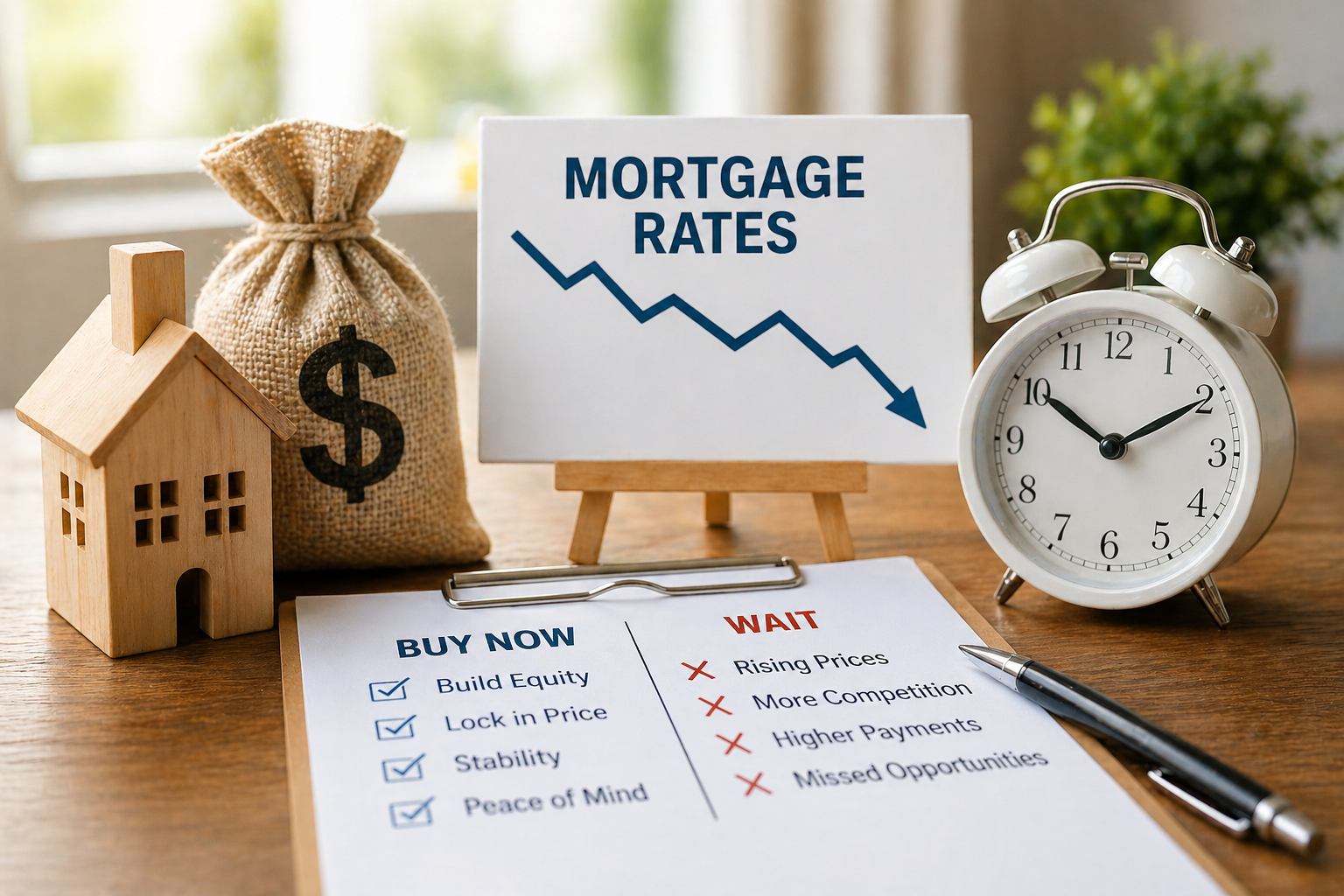
- Mortgage rates as of today (April 2026): Around 6.3% for a 30-year fixed, down slightly from ~6.8% a year ago. They’re not yet at pandemic lows.
- Mortgage rates 2026 forecast: Gradual declines are expected; Fannie Mae says ~5.9% by end of 2026. But rates could stay near 6% for much of the year.
- Southern California housing market 2026: Moderate price growth is likely. C.A.R. sees the median CA home price hitting ~$905k in 2026. Zillow forecasts LA-area prices up ~1.2% over the next year.
- Cost of waiting: Even a small price increase can add thousands to your cost. For example, delaying a $300k purchase for one year (with a 5% price rise) could cost $15k more, while only saving ~$100/month in interest.
- Should you buy now or wait?: If you’re financially ready and find a house you love at a price you can afford, buying now often makes sense. Waiting mainly makes sense if it improves your financial position (like boosting savings or credit). Otherwise, the missed equity and higher prices may outweigh the benefit of a slightly lower rate.
- Home buying timing strategy: Balance rate risk and price risk. Consider how long you plan to stay in the home and how the numbers work for you. Use multiple lenders and get pre-approvals. The right lender or mortgage broker (like those our team can recommend) can also help explain current programs that might ease costs.
Your Future Home Awaits with Jack Ma Real Estate
You have a dream home in mind, whether it’s a cozy bungalow or a modern condo, and Jack Ma Real Estate can help make it yours. Now is the time to act on your homeownership goals. Our experienced California agents offer personalized guidance through every step of the home-buying process. We stay on top of the latest data on mortgage rates and housing trends, so you don’t have to. Here’s why working with Jack Ma Real Estate is your best move:
- Local Expertise: We know the Southern California housing market inside out. We’ll help you target neighborhoods and price ranges that fit your budget and lifestyle.
- Timing Strategy: Unsure about waiting or jumping in? We’ll review current rates (e.g. “mortgage rates as of today”) and local trends with you so you understand the real trade-offs of waiting versus buying now.
- Tailored Assistance: From walking you through the application to recommending trusted lenders, our team is with you at every step. Think of us as your California homebuyer's guide.
- Negotiation Power: In a competitive market, getting professional help can be the difference between securing a home and losing out. We leverage up-to-date market data to negotiate the best deal.
- Peace of Mind: We’ll answer all your questions, no matter how basic or detailed. Ever wondered “is now a good time to buy a house?" or "Will mortgage rates go down more?” We'll give you clear, factual guidance so you can make confident decisions.
Ready to take the next step? Reach out to Jack Ma Real Estate today to schedule a free consultation. Whether you’re just starting to “browse home listings” or ready to make an offer, we can guide you. Call us at Jack Ma Real Estate to find your California homebuyer's guide and begin your journey. Your future home awaits, let’s find it together!
Frequently Asked Questions
Q1: Is now a good time to buy a house?
A: It depends on your personal situation. Currently, mortgage rates (around 6.3% as of April 2026) are higher than recent historic lows. Homes in California are still expensive (median price forecast ~$905k next year). If you are financially prepared (good credit, enough savings, stable income) and you find a home you can afford, many experts would say yes, it’s a good time to buy. Waiting for rates to drop could cost you more if home prices rise. However, if your finances need work (credit issues, or not enough savings), it could be worth taking a few months to strengthen them. Jack Ma Real Estate can help assess your readiness.
Q2: Will mortgage rates go down in 2026?
A: Forecasters expect a slight decline. For example, Fannie Mae predicted 30-year rates might end 2026 around 5.9% (down from ~6.4% in 2025). The National Association of Realtors expects rates in the mid-6% range for much of 2025, possibly falling closer to 6% by 2026. But rates are influenced by economic factors, so no one can guarantee a big drop. Plan for maybe 0.3–0.5% lower by year-end, but be prepared for rate moves either way.
Q3: What is the cost of waiting to buy a home?
A: Waiting can save you a little in interest if rates fall, but it can cost you more in purchase price. For instance, delaying buying a $300k home by a year (with a 5% price increase) might save about $100 per month, but you’d pay $15,000 more upfront and lose a year of equity. Over time, that lost equity and higher loan amount can outweigh the monthly savings. In short, every month of waiting potentially adds to the home’s price you must finance and shortens the time your money is building equity.
Q4: How do I decide between buy now or wait?
A: Compare the scenarios: if you wait, what rate might you get versus what price increase might happen? Crunch the numbers (or ask us, we can help run the math). Also factor in your life plan: if you’ll move in a few years, small changes matter less. If you’ll stay 10+ years, locking in homeownership now often pays off. Consider rent costs too: in some cases, the money you pay in rent could help you qualify for a mortgage. Ultimately, your best “timing strategy” balances market data with your personal readiness. Jack Ma Real Estate can provide current data and run these scenarios with you.
Q5: How can Jack Ma Real Estate help with buying a home?
A: We offer a full California home buyers guide and one-on-one service. Our agents will:
- Educate you on current mortgage rates, local market stats, and loan options.
- Help you get pre-approved so you know your budget.
- Show you listings that match what you want in Southern California.
- Negotiate on price, repairs, and terms on your behalf.
- Guide you through inspections, paperwork, and closing.
Think of us as your partners – we’re here to take the guesswork out of home buying and help you find a great home at a price you can live with.
Whether you decide to move forward now or just want more info, don’t hesitate to contact Jack Ma Real Estate. We’re dedicated to making your home-buying experience clear and stress-free. Good luck on your journey to homeownership!
Check out this article next