

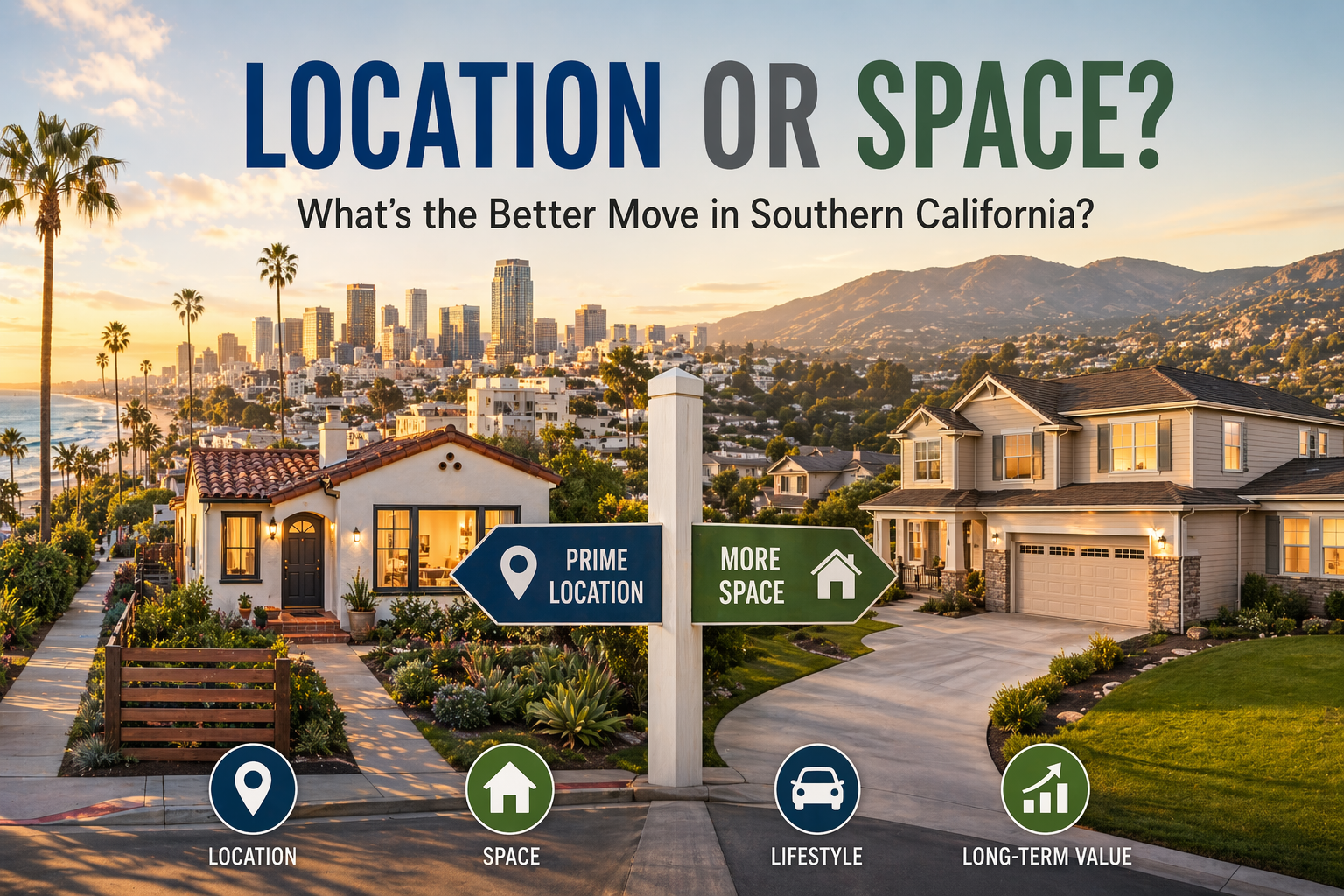
Southern California real estate is notoriously expensive, forcing many homebuyers to weigh location against square footage. In 2026, California’s median home price is forecast to rise to about $905,000, and prime markets like Los Angeles already top that. For example, by late 2025 the median sale price in Los Angeles County was roughly $943,000, whereas nearby Riverside County (Inland Empire) was about $630,000. These price gaps capture the central dilemma: a smaller home in a prime beach or city locale may cost as much as a much larger house farther inland. This article explores the Southern California housing market (2026 forecasts and trends) and compares costs and lifestyle factors so you can decide what matters most, prime location or extra space.
Southern California Housing Market Outlook 2026

The overall housing market in California is projected to improve modestly in 2026. Sales of existing single-family homes statewide are expected to tick up about 2% (to ~274,400 units), as mortgage rates slowly decline. In fact, 30-year fixed rates are forecast to drop to around 6.0% by 2026, helping affordability a bit. Inventory levels are also rising: active listings could increase by roughly 10%. Median home prices are still at record levels (California’s median is around $905K in 2026) but with slower year-over-year growth. Notably, Southern California’s major markets are diverging: high-demand coastal and metro areas remain very pricey, while inland regions see somewhat lower prices and stronger sales growth. In practice, this means the housing market in SoCal 2026 still favors sellers in top areas, but buyers may find better deals or negotiating power outside the core.
For example, a recent analysis noted that Los Angeles County’s median sale price was about $942,610 by the end of 2025, whereas Riverside County was $629,950 (all Southern California combined). These figures (with Orange and San Diego counties usually somewhere in between) illustrate the split market. In general, affordable homes in Southern California are more abundant in the high desert and Inland Empire, while the best beach and city areas command premium values. First-time buyers should especially note the rate trend: stubbornly high rates (around 5–6% through 2025) have kept some people on the sidelines, but any rate relief in 2026 could tip more buyers toward action. On balance, California experts forecast slow, steady price gains in 2026, with Southern California reflecting that trend with mild home price increases but much stronger inventory and lending support than in the overheated past.
Price and Affordability: City Homes vs Suburban Houses
The most obvious difference between a small home in a prime spot and a big house far out is price and space. In Southern California, location heavily drives price-per-square-foot. For instance, recent data show the median price per square foot was roughly $594 in Los Angeles vs about $323 in Riverside (the latter part of the Inland Empire). In other words, an L.A. City homes cost almost double per foot compared to IE homes. This translates to dramatically different home sizes for the same money. A $900,000 budget might buy a 1,000 sq ft condo near the coast or a 3,000 sq ft house inland.
Similarly, median home values differ greatly by area. The current median listing price in Los Angeles is about $1,195,000, while in Riverside County it’s in the $600-650K range. Even within Los Angeles County there’s a huge spread: an expensive suburb like Santa Monica has average home values around $1.72M, whereas more affordable LA suburbs (like Lancaster, Palmdale, and Norwalk) often list median homes well under $500K. For example, Lancaster (about 60 miles north of downtown LA) had a median home value of only $159,200 in one report. Norwalk (a southern LA suburb) was around $315,500, compared to Beverly Hills or Santa Monica, which are often double that.
In practical terms, a small home vs a big house boils down to how much space and privacy you want vs. what price you can afford. Suburban houses in Riverside, San Bernardino, or the high desert often come with multiple bedrooms, yards, and sometimes guest space, all at prices that inner-city buyers can only dream of. For example, towns like Fontana or San Bernardino (Inland Empire) feature many newer homes under $500K, whereas coastal cities often have no homes below that price point. On the other hand, those cheaper inland markets usually require buying a smaller lot (perhaps 0.2–0.5 acre) and living much farther from amenities.
Aside from purchase price, remember ongoing costs vary too. A bigger home means higher property taxes, insurance, and maintenance. But a smaller urban home may come with hefty HOA fees or land lease payments (especially in some coastal communities). In general, a walkable urban condo might have lower taxes, but owners pay HOA dues. A suburban house pays more tax (since valuations are higher) and likely has utility costs for landscaping and repairs. Buyers must budget for these differences when comparing a small prime home versus a larger suburban one.
Lifestyle and Location: Commute, Schools, and Amenities
Beyond finances, lifestyle factors are key. A home’s location dictates daily life: commute times, neighborhood feel, and local amenities. Los Angeles-area suburbs and coastal cities offer many perks but at a price. If you buy a small home in a top location (e.g. Westwood, Santa Monica, or a downtown L.A. condo), you’ll enjoy proximity to jobs, restaurants, and entertainment. You can often walk to shops, take public transit, and avoid long highway commutes. However, these neighborhoods have significantly higher prices and often less square footage (small yards or no yard). For example, Santa Monica’s average home value is around $1.72M and lot sizes are tiny. Even modest 2-bed condos in desirable coastal or Westside locations can easily run into the high $800K–$1M range.
In contrast, suburban and exurban living means more space and quiet neighborhoods. In cities like Riverside, Moreno Valley, or Temecula, you can get a large yard, multiple bedrooms and even a pool for the cost of a tiny condo in the city. Suburbs also typically have lower crime rates and good schools. Indeed, one source notes that “suburbs tend to be more affordable and have lower crime rates. Additionally, many suburbs offer good schools and plenty of green spaces”. Communities in Orange County (Irvine, Yorba Linda) or the San Gabriel Valley (Pasadena, Arcadia) are famous for top-rated public schools, but bear in mind those areas are not cheap. Still, many inland school districts have improved greatly, and suburbs like Chino Hills or Claremont offer nice schools with bigger houses, albeit with commute trade-offs.
The Real Cost of Distance: Commute, Transit, and Lifestyle Trade-Offs
Speaking of commutes: Southern California’s infamous traffic is a major factor. Average commute times are already long, even for city residents. Los Angeles County’s median one-way commute is about 30.4 minutes. That means half of Angeleno workers spend over 10 days per year sitting in traffic. If you live in further-out suburbs, expect even more time behind the wheel. For example, residents of San Bernardino County (Inland Empire) have an average commute around 32.3 minutes vs 29 minutes in Los Angeles County, despite working farther from many jobs. In fact, San Bernardino County is a net exporter of commuters: roughly 222,000 people drive into Los Angeles each day for work. Commuting from the far east or High Desert can easily add an extra hour each way during rush hour.
Transit options also differ. In LA County, only ~9% of commuters use public transit (versus 1–2% in most of Inland Empire). However, areas like Long Beach, Pasadena, and downtown LA are well-served by Metro buses, light rail, and even bike lanes. If you take transit or prefer to avoid freeways, the city/suburbs close to rail lines (e.g. Metro Gold Line areas) have an edge. In many Inland suburbs, a car is virtually required for all errands.
Neighborhood amenities are another point. Urban and coastal locations put beaches, major employers, restaurants, and cultural centers at your doorstep. Moving out gives you neighborhood parks, local schools, and often a tighter-knit community. For example, Santa Monica or Newport Beach offer coastal vibes and nightlife (but steep prices), whereas a place like Redlands or Temecula offers wineries, golf courses, and mountain views at lower cost. Ultimately, consider what matters: if you cherish a short commute and access to city life, a smaller home in a prime location might pay off in daily convenience. If your priority is space and you don’t mind longer drives, a bigger home on the outskirts may provide better value.
Buying vs Renting and First-Time Buyer Tips
For many Southern California buyers, the decision also involves renting vs buying. Recent analysis shows that renting often costs less month-to-month, while buying builds equity. For example, in Los Angeles a median-priced home (~$1,005,000) would have an estimated monthly mortgage of about $6,568, whereas average rent runs about $2,991. That’s a difference of roughly $3,577 more per month to buy. A similar pattern holds in San Diego and other coastal markets. Over five years, these rent vs buy gaps can translate to hundreds of thousands of dollars. On the other hand, homeowners benefit from home value appreciation and tax deductions, whereas renters do not build equity.
First-time buyers in California face some additional hurdles. High prices and down payments are often daunting, but there is help available. California offers various assistance programs (CalHFA, FHA loans, down payment grants, etc.), which can make a $500K–$900K home more accessible. First-time homebuyer tax credits and low down-payment mortgages are options to explore. It’s wise to consult a local lender or housing counselor early. In this market, many agents also recommend comparing “rent vs buy Southern California” costs carefully: sometimes renting a year or two and saving can expand your options, but be mindful that climbing prices and interest rates could keep rentals high too.
From an investment perspective, both location and home size matter for future value. Coastal and central LA locations generally hold their value well due to constant demand and limited new supply. Suburban and inland homes might appreciate faster if population and job growth continue (as has happened in the Inland Empire for years). In fact, observers point out that the Inland Empire is one of the fastest-growing regions in the U.S., suggesting investment upside if the trend holds. Real estate investors in Southern California often balance these factors: prime neighborhoods may yield slower rent growth but low vacancy, while affordable suburbs might offer higher rental yields and price appreciation. Whatever your goals, know that “location vs size” is also a location vs opportunity calculation.
Pulling It Together: Location vs Size in Southern California
Choosing between a smaller home in a prime area or a larger house farther out boils down to personal priorities. Here’s a quick checklist:
- Budget and Space: How much do you want to spend, and how much space do you need now (and in future)? Inland and suburban homes give more space per dollar, while urban spots demand a premium.
- Commute Tolerance: Is a long commute acceptable if it means a bigger house, or do you prioritize a short drive/better transit? If you work downtown or rely on transit, living closer can improve quality of life (the median LA commute is ~30 minutes). If you work remotely or closer to the suburbs, commuting may be less of an issue.
- Lifestyle: Consider nearby amenities, schools, and community. Prime locations may have walkable dining/shopping and diverse cultural offerings. Suburban areas often have parks, newer schools, and a quieter atmosphere.
- Future Plans: Are you looking to invest long-term, or might you move or upgrade again? If it’s an investment or a home you’ll keep 10+ years, think about expected market trends: central areas can be more stable, while developing suburbs might gain ground.
In recent Southern California market conditions, inventory is slightly easing, but affordability remains a challenge. A smaller urban home might be more attainable with a given down payment than a mansion-style suburban home (because the latter costs millions). Yet an inland home could still cost much less overall. Many buyers find a compromise: for example, choosing a mid-sized home in a mid-range suburb (such as some parts of San Gabriel Valley or OC) rather than going extreme on either end. Use tools like local market reports, affordability calculators, and agent expertise to compare neighborhoods. Remember to factor in taxes, insurance, and commuting costs for each option.
Summary: The “best” choice depends on what you value more location or space. For some, the energy of city life and a shorter commute justify a smaller lot or home. For others, a yard and extra room (especially for growing families) is worth the drive. Given the 2026 Southern California housing market forecast (steady prices, improving inventory), buyers have a bit more leverage but not a wide-open market. Tour properties in both categories, compare monthly costs, and envision daily life in each. With careful planning, you can find the right balance between an ideal location and a comfortable size.
Final Thoughts: Making Your Choice

Buying a home is a big decision, and in Southern California it can be complex. There’s no one-size-fits-all answer to the small-home vs. big-house question. A prime location home offers convenience and lifestyle perks at a higher price per square foot, while a larger suburban home offers more elbow room for less money but adds commute time. The trends for 2026 suggest slight price gains and more listings, so now is a good time to seriously explore your options. Think through your budget, lifestyle needs, and how long you plan to stay. Weigh the obvious costs (purchase price, mortgage, taxes) and hidden ones (maintenance, commute time, HOA fees). And remember, Southern California is diverse; you might discover a neighborhood you hadn’t considered that fits your priorities perfectly.
Whatever you decide, make sure it aligns with your long-term goals. If space is at the top of your wish list, the Inland Empire or high desert may be your best place to buy a house in Southern California. If your career or community ties pull you to the coast or Los Angeles suburbs, expect to pay more for location. In either case, the information and data are on your side: use them along with local real estate advice to move forward confidently.
Your Dream Home Awaits. Contact Jack Ma Real Estate
Are you ready to take the next step? Jack Ma Real Estate specializes in Southern California homes, whether you seek a cozy neighborhood cottage or a spacious family estate. Our experienced team knows the local market and can help you compare small-city homes with large suburban houses. We can answer your questions about financing, neighborhoods, and what’s available in 2026. Don’t navigate this decision alone; let us guide you to the right home for your life and budget. Contact Jack Ma Real Estate today for personalized advice and to start touring properties. Your perfect Southern California home could be just a call away!
Frequently Asked Questions
Q: How do I decide between a smaller home in the city and a larger house farther out?
A: Consider your priorities. Think about budget vs. space needs, commute tolerance, and lifestyle. If being near work, schools, or amenities is important, a city home might win. If you need a yard and more rooms, suburbs may be better. Compare the total costs (mortgage, taxes, maintenance) and time spent commuting. Use local market data (prices, interest rates) to inform your choice, and consult a realtor to crunch the numbers.
Q: Are there affordable areas in Southern California where first-time buyers can get a house?
A: Yes. Generally, the most affordable homes are in the Inland Empire (San Bernardino and Riverside counties) and further out (Victorville, Palmdale, Lancaster). Some affordable LA County suburbs (Norwalk, Carson) and certain Orange County cities (parts of Anaheim) can also be lower-cost. Inland Empire cities have median prices often $200k–$500k less than LA or coastal areas. However, affordable areas usually mean longer commutes. First-time buyers should also check for government programs and grants in their target area.
Q: Is it better to rent or buy in Southern California right now?
A: It depends on your situation. Currently, renting generally costs less each month, while buying builds equity. One analysis shows buying in LA or San Diego costs roughly $3,000 more per month than renting. If you value stability and eventual ownership, buying can be a good investment, especially if rates drop. But if affordability is an issue or you need flexibility, renting might make sense short-term. Compare local rent vs. mortgage costs and also factor in future price trends and how long you plan to stay.
Q: What should first-time home buyers in California know?
A: First-time buyers should get pre-approved for a mortgage, determine a realistic budget (including down payment, closing costs, taxes), and learn about assistance programs (like CalHFA loans or down payment grants). The market is pricey, so saving for a larger down payment can improve your options. Also, factor in maintenance costs and home insurance. Working with a local real estate agent can help you identify homes that fit both your needs and your budget.
Q: How is the 2026 Southern California housing market affecting buyers?
A: The outlook for 2026 shows mild price increases and improving conditions. Mortgage rates are expected to ease toward ~6%, and inventory is up, giving buyers a bit more choice. Buyers should still expect competition in desirable areas, but interest rates may be more favorable than in 2024-25. First-time buyers and investors are advised to shop around as more homes come on the market. Overall, 2026 may be a better time to buy than the prior few years, but affordability is still a challenge in top neighborhoods.
Check out this article next