

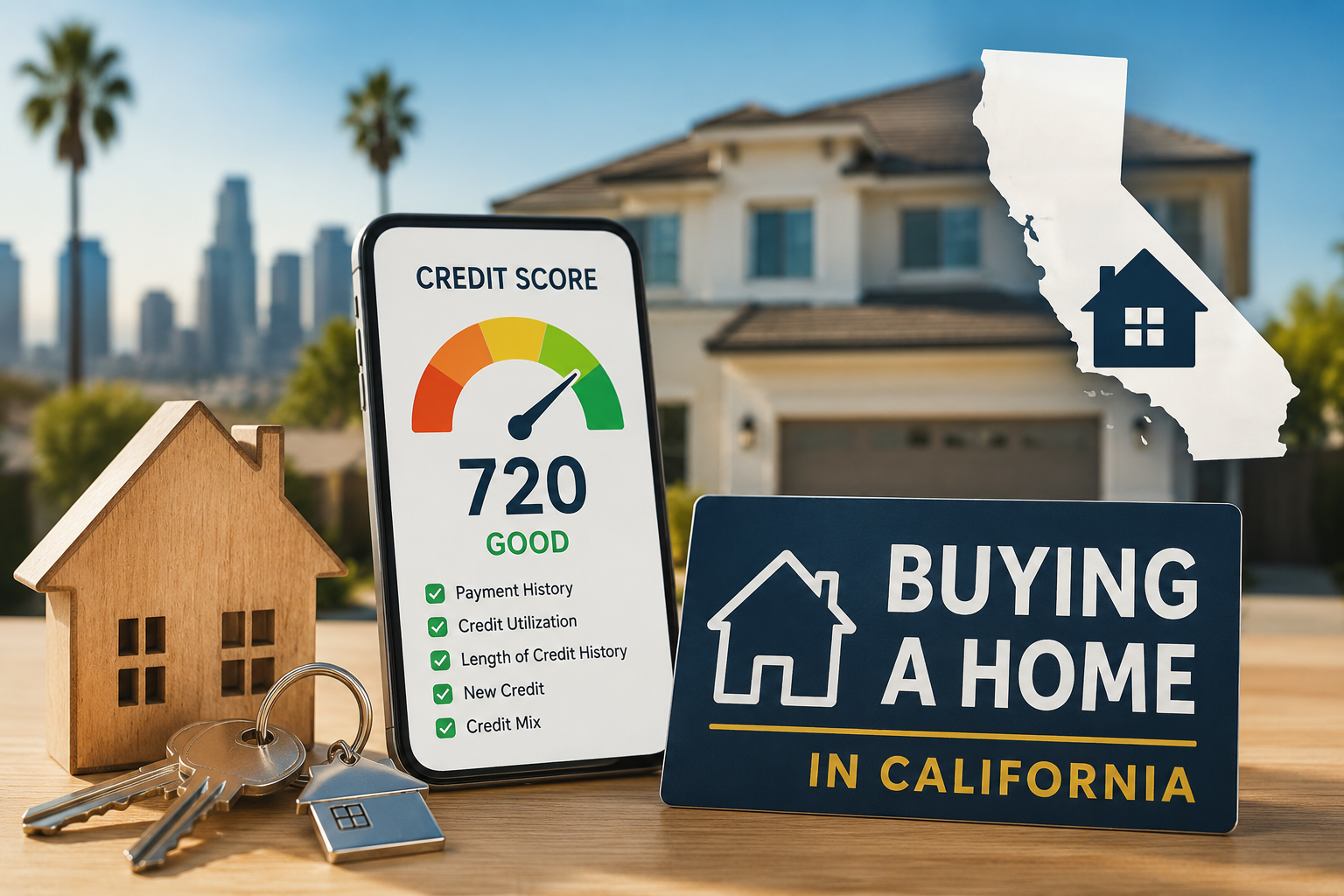
Your credit score is one of the key factors lenders use to decide if you can get a mortgage and at what cost. In 2026’s high-cost California market, even a few points can make a big difference in what you pay. For example, improving from a 620 to a 740 FICO score can save thousands over the life of a loan.
This graphic highlights how different FICO score ranges correspond to mortgage rate categories. It shows that top-tier credit (around 740+) leads to the best interest rates, while very low scores face the highest costs. The visual makes it clear why even a small increase in your score can move you into a much lower-cost loan.
Understanding Credit Score Ratings

Credit scores typically range from 300 to 850. A score of about 740 or higher is considered “very good,” but you don’t need that high a score to buy a home. Lenders use your score (often a FICO® score) to predict how likely you are to repay a loan on time. According to the Consumer Financial Protection Bureau (CFPB), your credit report and score “determine whether you’ll be able to get a mortgage and the rate you’ll pay." In other words, better payment history and lower debt generally mean a higher score and better loan terms. You can check your credit reports for free (at AnnualCreditReport.com) and look for errors or overdue payments that might be hurting your score.
California Mortgage Requirements and Score
California home prices are far above the national average, so loans here tend to be larger. For 2026, the Federal Housing Finance Agency sets the baseline conforming loan limit around $806,500, rising to $1,209,750 in expensive counties like Los Angeles and San Francisco. Any loan amount above those limits is a jumbo loan, which usually requires a very good credit score (typically 700 or higher) and a sizable down payment.
Different mortgage programs have different credit requirements:
- Conventional loans: Lenders usually want a FICO score of about 620 or above for standard 30-year fixed-rate mortgages. Borrowers with scores much below 620 often won’t qualify for a conventional loan.
- FHA loans: These government-insured loans help buyers with lower credit or smaller savings. The FHA requires a minimum score of 580 for the 3.5% down-payment option, or at least 500 if you provide 10% down.
- VA loans: For eligible veterans and service members, VA loans have no official score floor, but most lenders expect around 620. VA loans allow 0% down and no mortgage insurance.
- USDA loans: For buyers in eligible rural areas, USDA-guaranteed loans allow 0% down, but lenders typically look for a score around 640.
- Jumbo loans: In high-cost California markets, jumbo mortgages (above conforming limits) are common. These usually demand a 700+ credit score and 20% or more down.
In general, a minimum credit score of about 620 is needed for most traditional home loans. If your score is lower, you may still qualify with an FHA or VA loan, but expect higher costs or additional requirements (like a larger down payment or stricter debt-to-income checks).
Credit Score and Mortgage Rates
Your credit score directly affects the mortgage rate you pay. Lenders use your score to judge risk: a higher score suggests lower risk, so you get a lower interest rate; a lower score means higher risk and a higher rate. For example, lenders often treat a FICO score of 740+ as a top tier (best rates) and anything below 620 as high-risk.
Even a small difference in rate can cost a lot on a California mortgage. On a $403,000 loan (about the average new mortgage in late 2024), a borrower with a 760+ score might pay around 7.24% APR, resulting in a $2,746 monthly payment. A borrower with a 620–639 score at roughly 7.84% APR would pay about $2,911 monthly. That difference of $165 per month amounts to roughly $59,000 more in interest over 30 years for the lower-score borrower.
Because of this, improving your home loan credit score even by a small amount can save thousands. Moving up just one rate tier can lower your APR. Even a 20–30 point increase can move you into a cheaper rate bracket. Always compare lenders’ rates, and if possible, delay your purchase until you boost your score to qualify for a better rate.
The California Housing Market in 2026
California’s housing market remains extremely costly. Mid-tier home prices in California are around $775,000 (more than double the U.S. mid-tier median). Even entry-level homes (5th–35th percentile) cost about 30% more than similar homes nationwide. With home prices so high, mortgages tend to be large relative to incomes. As of 2026, only about 46% of California households can afford a bottom-tier home (down from 57% in 2019), and only 23% could afford a median-priced home. The rest of the buyers must qualify for loans that stretch their income limits.
Mortgage interest rates have jumped from historic lows. Before 2022, rates were near 3%; by late 2025, they approached 7%. Most current California homeowners locked in those low rates, making them reluctant to move (selling a home and rebuying at a higher rate could raise their payments by roughly 11%). This means inventory is limited and competition is stiff. For example, owning a typical two-bedroom home in California will cost about $4,440 per month (mortgage) in early 2026, compared to $2,700 to rent. That 66% premium on ownership highlights why securing the lowest possible interest rate (through a higher credit score) is so important.
In short, in California’s 2026 market, you need strong financing. A higher credit score can be the difference between a mortgage you comfortably afford and one you can’t. Lenders will also look at your income, savings, and debt-to-income ratio, so plan accordingly. But a credit score is one of the biggest levers you control to qualify for and afford a home here.
First-Time Homebuyer Programs and Credit in California
First-time buyers in California have some special programs, but they still need to meet credit checks. The FHA loan is popular among first-timers with modest savings; you can buy with just 3.5% down if your score is 580 or above. FHA allows even lower scores (500–579) with 10% down. California’s own homebuyer programs (through CalHFA and local governments) offer down-payment assistance or grants, but they often require credit scores in the mid-600s. For example, many CalHFA programs require around a 640 FICO score. If your score is lower, you might pair FHA with CalHFA grants.
Programs vary by area. For example, Los Angeles County’s Mortgage Credit Certificate can give first-time buyers a tax credit of up to 20% of their annual mortgage interest. San Diego County offers a low-interest loan covering up to 22% of the purchase price for a down payment. Orange County provides second mortgages for 20% of the home’s price (up to $80,000) to eligible buyers. San Francisco’s program can supply up to $500,000 (deferred) for qualifying down payments. San Mateo County even lets buyers use just 5% down with no PMI. Each of these programs has income and credit rules. In practice, many first-timers with lower credit use FHA loans, possibly with one of these local programs. Improving your credit score opens more of these options and usually improves the terms (even lowering mortgage insurance or interest).
Mortgage Approval Tips and Improving Your Credit Score
To boost your home loan approval chances and get better rates, focus on your credit now. Key tips:
- Check and fix your credit reports. Order your free reports from the three bureaus and review them carefully. Dispute any errors (wrong balances, accounts you didn’t open) promptly. Removing mistakes can raise your score.
- Pay all bills on time. Payment history is ~35% of your FICO score. Set reminders or autopay for your credit cards, utilities, loans, etc. Even one late payment can ding your score.
- Reduce credit card balances. Try to keep each card’s balance under 30% of its limit (and as low as possible). High utilization signals risk. Paying down balances or moving debt to a single loan can quickly lift your score.
- Avoid new credit inquiries. Each time you apply for a loan or credit card, it can shave points off your score. Don’t open new accounts in the months leading up to a mortgage application. Also, keep old accounts open to lengthen your history.
- Save for a larger down payment. Even if a program lets you put 3–5% down, having 10–20% ready makes you a stronger borrower. More equity up front lowers the lender’s risk and can offset a borderline credit score. It also eliminates or reduces mortgage insurance.
- Monitor your credit. Use free tools or alerts to watch your credit reports and score. Catching identity theft or sudden score drops quickly lets you fix issues before applying for a loan.
Putting these steps into practice over several months will raise your credit score and strengthen your mortgage application. Lenders see borrowers who manage debts well and have savings as lower risk. In the meantime, gather documentation (income, assets, employment history) so you’re ready to apply as soon as you meet the credit and income targets.
Simple habits like on-time payments and paying down debt can significantly boost your credit score. Paying all your bills on time builds a strong payment history. These habits strengthen your credit profile and help get your loan approved.
Real Estate Financing in California
Finding the right loan is about matching your credit profile to the program. In California:
- Conventional loans: Require ~620+ FICO and typically 20% down to avoid PMI. If you put less down, you’ll pay mortgage insurance (PMI). A higher credit score lowers your mortgage rate and your PMI rate, saving money.
- FHA loans: Require at least 580 FICO for 3.5% down, making homebuying possible with lower credit or savings. FHA loans allow smaller down payments but carry mortgage insurance premiums.
- VA/USDA loans: Allow 0% down, but usually expect 620–640+ FICO. VA loans have no mortgage insurance; USDA loans have an annual fee instead.
- Jumbo loans: Needed in markets above conforming limits (e.g., high-end homes in Bay Area, LA). These demand ~700+ FICO, 20% down, and cash reserves.
Lenders also check your debt-to-income (DTI) ratio (typically max 43–50%). If your debts are high, pay down loans before applying. Work with an experienced lender or real estate agent in California, they’ll know local programs and limits. Many buyers use state and local help (like CalHFA’s low-down-payment loans, or county grants), so ask about programs in your area.
In short, improve your credit score to unlock the best mortgage. It affects your rate and loan eligibility. Pair good credit with research on California’s first-time buyer programs or down payment assistance, and you’ll be in a much stronger position to buy.
Key Takeaways: Strengthen Your Home-Buying Power
In California’s 2026 market, your credit score is as important as your savings. A higher credit score rating opens more loan options (FHA, conventional, jumbo) and secures a lower mortgage interest rate. That can translate to hundreds of dollars saved each month and tens of thousands over the loan’s life. Even small score gains help: raising your FICO by a few dozen points may move you into a cheaper rate tier.
Start preparing now. Review your credit reports and address any issues. Pay down debt, keep cards active but low, and avoid opening new accounts. Research loan programs; FHA, VA, and state assistance can work with lower scores and down payments. Talk to a California lender to understand exactly what credit score and income you’ll need for homes in your price range.
The bottom line: Improving your credit score increases your home-buying power. With good credit, stable income, and the right support, you’ll be ready to make a strong offer on your California dream home.
Your Homeownership Journey Starts Now

Jack Ma Real Estate is here to help you achieve your homeownership goals. We understand how credit scores affect mortgage options in California’s market. Our experienced team will review your credit profile and explain which loan programs fit your situation. Whether you need advice on raising your credit score or help finding the right first-time buyer program, we provide clear, personalized support. Contact Jack Ma Real Estate today to get expert guidance on improving your credit and securing the best financing terms for your purchase today.
Frequently Asked Questions
What credit score do I need to buy a home in California?
Most conventional lenders want around a 620 credit score or higher. However, FHA loans allow lower scores (580+ with 3.5% down, 500+ with 10% down). VA loans often require ~620, and USDA loans ~640. In practice, the higher your score, the more loan options you’ll qualify for.
How does my credit score affect my mortgage rate?
A higher score generally means a lower interest rate. Borrowers with scores in the top tier (around 740+) get the lowest rates. Even a small score increase can move you into a better rate bracket. For example, one source showed a borrower with a 760+ score paying about $2,746/month on a $402K loan versus $2,911/month for a 620-score borrower. Over time that adds up to tens of thousands saved.
Can I still buy a home with a credit score of 620 or below?
Yes, but your options may be limited. With a 620 score, you could qualify for FHA loans (down to 580) or VA loans (if eligible). These loans allow smaller down payments. You might pay slightly higher rates or mortgage insurance, but it’s possible to get a mortgage. Raising your score, even slightly, can improve your terms.
What mortgage options exist for first-time buyers with less-than-perfect credit?
Many first-time buyers use FHA loans, which accept 580+ scores. California also offers special programs (through CalHFA and local governments) that provide down-payment help or low-interest second loans. For instance, many counties offer grants or low-cost loans. These programs usually require credit in the mid-600s, so improving your score will open more options.
How can I improve my credit score for a mortgage?
Check your credit reports for errors and dispute any mistakes. Pay all bills on time and reduce high balances. Keep older accounts open and avoid new credit inquiries right before applying for a mortgage. Using credit responsibly for several months (even 20–30 point increases) can significantly improve your loan terms. Consistent good habits are key.
Check out this article next