
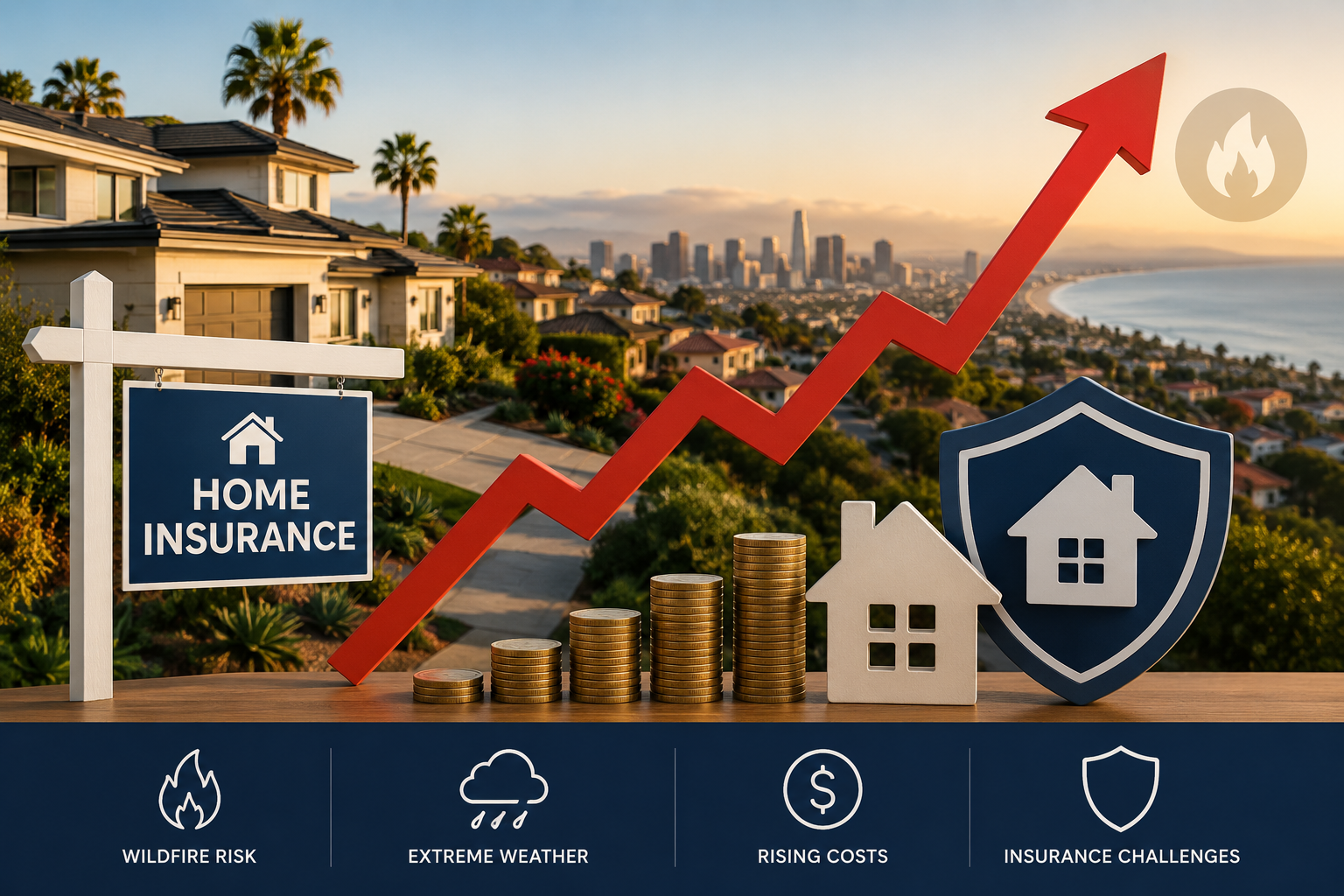
Homeowners in Southern California are facing a surprising new hidden cost of buying a home: sharply rising insurance premiums. What was once a modest line item on the monthly budget is now exploding. Analysts say this trend is driven by a convergence of factors unique to California’s climate and housing market. In just a few years, homeowners have seen insurance quotes jump, sometimes doubling or tripling at renewal. This surge is spurring anxiety among buyers and sellers alike, as insurance is now a critical component of homeownership costs and real estate affordability in the region.
Why Southern California’s Insurance Crisis Is Reshaping the Housing Market

The Southern California real estate market, from Los Angeles to San Diego, has weathered back-to-back catastrophes. Wildfires, atmospheric rivers, and drought stress have combined to upend insurers’ pricing models. For example, the January 2025 Palisades/Eaton wildfires alone cost insurers an estimated $40–$50 billion in claims, the largest US wildfire loss on record. At the same time, a record‐wet November 2025 in Los Angeles and Ventura Counties (7–10 inches of rain in some areas) has raised fresh fears of mudslides and flooding. In a nutshell, insurers see year-round, all-hazards risk stacked on top of very high property values in Southern California.
As a result, nearly all major carriers are repricing policies. Some have stopped issuing new home policies or outright left California’s private market. Others have filed for hefty rate increases: for example, Mercury Insurance (the 3rd-largest CA home insurer) plans an 8.2% rate hike for homeowners in 2026, and AAA’s CSAA just raised rates by 6.9%. Even the California FAIR Plan (the insurer of last resort) is proposing an average 30% premium jump. All of this means homeowners insurance rates are climbing much faster in California than the national average.
Below we break down the main causes, the impacts on SoCal homebuyers, and what you can do about it. Throughout, we’ll weave in key terms like “home insurance prices,” “wildfire insurance California,” and “homeownership costs” to make this post SEO-friendly and informative.
Main Drivers of SoCal Insurance Price Spikes
Several high-impact factors explain why home insurance premiums in Southern California have shot upward so fast:
- Catastrophic Wildfire Losses: California has suffered record fires in recent years, especially in Southern and coastal regions. The Palisades/Eaton fires (Jan 2025) alone destroyed over 16,000 structures and generated roughly $40 billion in insured claims. More broadly, California saw 15 of its 20 costliest fires since 2015 in the past few years. This climate-driven wildfire risk is now built into premiums: insurers charge wildfire insurance in California at a premium. Areas with wildfire history or poor access roads regularly see 50–100% higher rates than safer suburbs. In fact, one analysis found that typical insurer quotes in Pacific Palisades jumped 33% above inflation from 2018–2022. (Non-renewals have also risen: Palisades and Altadena had higher cancellation rates than state averages before their 2025 fires.)
- Extreme Weather and Flood Risk: Southern California isn’t just about fire; it’s now all-hazards. The unprecedented rains and mudslides of late 2025 (e.g., atmospheric river storms inundating Los Angeles, Ventura, Orange, and San Diego) revealed vulnerabilities. Flood and mudslide insurance costs are climbing as insurers rebalance portfolios. One insurance blog notes that Southern California’s “record-wet November" reinforces that this is more than a wildfire story. It is an all-hazards, year-round risk." Reinsurers (the backstop insurers for insurance companies) have dramatically repriced property risk in California after these events. Because home values are so high, even moderate floods cause massive claims.
- Rising Reinsurance Costs: After big losses, insurers buy more reinsurance at much higher prices. Historically, California barred insurers from passing reinsurance costs to policyholders, but recent rules (the Net Cost of Reinsurance law) lifted that ban. Reinsurance rates in California have nearly doubled since 2017. Insurers now can (and will) add those rising costs into homeowner premiums; industry estimates suggest reinsurance could bump California premiums 40–50% higher. In effect, a global reinsurance hard market (after years of payouts) directly translates to higher homeowners insurance rates here.
- Construction & Labor Inflation: Rebuilding a damaged home costs far more today than it did in the past. California saw record construction cost increases; Los Angeles construction costs jumped 5.9% year-over-year (Q4 2024) and are up about 44% over five years. Lumber prices, skilled labor shortages, and new building codes all drive this up. As insurers calculate replacement-cost coverage, higher rebuild costs mean larger claim payouts. They respond by raising premiums. Some insurers are even requiring higher coverage limits, so homeowners collectively face higher bills. (This feeds back into home insurance policy premiums as well; raising the required coverage raises the price.)
- Insurance Market Dynamics: California insurers have lost billions in recent years. State Farm (the state’s largest home insurer) reported $5 billion in losses over nine years. Many big carriers have pulled back or refused new policies in high-risk zones. When competition thins, remaining carriers can charge more. Also, even policies outside fire zones are ticked up: under new regulations, insurers are raising wildfire rates across the board (since non-renewal moratoria ban pulling policy renewals only in fire zones). In short, the insurance market has shifted from plentiful cheap coverage to a more squeezed market with higher rates and stricter terms.
- FAIR Plan Limits: The California FAIR Plan, the “insurer of last resort” for high-risk homes, is also getting more expensive. FAIR plan policies offer only basic fire coverage and no personal property protection, but they’ve grown explosively (to ~670,000 policies by late 2025) as private insurers leave high-fire areas. The FAIR Plan is proposing rate hikes averaging 35–40% in 2026. Even if only private-market buyers leave, those premiums indirectly pressure neighborhood pricing (home values of insured neighborhoods can be depressed by high FAIR Plan usage).
Taken together, these factors mean that what used to be a single-digit annual insurance increase has morphed into double-digit jumps. Experts now expect California homeowners could see average rate increases in the mid-teens (16%+) by 2026, far above the roughly 4% national average. In some areas or high-risk homes, rate hikes of 40–100% are already reported. This is why Southern California real estate buyers now treat insurance as a central concern.
Impact on Southern California Homebuyers
Rising insurance costs are more than a budget headache; they’re reshaping affordability and market behavior in SoCal:
- Higher Total Homeownership Costs: Monthly mortgage estimates now include far higher insurance line items. For example, the California Legislative Analyst notes that in March 2026 the typical mortgage payment for a two-bedroom California home (with taxes and insurance) was about $4,440 per month versus roughly $2,700 rent, a 66% premium. Insurance alone now makes up roughly 9% of the monthly mortgage payment, an all-time high nationally. In high-risk ZIPs it can be much higher. This squeezes budgets: many would-be buyers must qualify for larger loans (due to insurance) or settle for cheaper homes farther from the coast.
- Hidden Costs of Buying a Home: Traditionally, buyers budget for a down payment and mortgage but may overlook insurance increases. Now insurance is a hidden cost of buying a home that can break a deal. Lenders require proof of insurance before closing, so buyers discover at the last minute that their new home costs hundreds more per month to insure. Some deals fail as buyers can’t afford the cumulative payment (mortgage + taxes + new insurance).
- Market Slowdown: High insurance is damping demand. Realtors report losing buyers because they “can’t get policies or the policies are too high in price,” especially for homes $1-2M+. In pricey areas, new insurance quotes can add $800–$1,000 a month (or $10k/year) to ownership costs. That can turn a $2M home’s monthly cost from $8,000 to $9,000. When buyers balk, home sales stay flat despite rising inventory.
- Value Impacts: In high-fire areas, expensive or unavailable insurance is already knocking down property values. A recent analysis found that since 2018, premiums and climate risk have reduced home values by roughly $20,500 in the top 25% of exposed homes and $43,900 in the top 10% (those with the highest catastrophic risk). Simply put: homes that face sky-high insurance bills don’t command the same price. Sellers must often price below market if buyers fear unaffordable insurance. In some cases, homes in remote or brush-heavy zones go off-market entirely because lenders won’t issue loans without adequate coverage.
- Rent vs. Buy Decisions: Some Californians are weighing renting longer, given soaring homeownership costs. The “rent vs buy math” has shifted. With rents relatively stable, the extreme costs of ownership (mortgage + high insurance + taxes) make renting seem more attractive for longer than in the past. This dynamic can further soften the housing market, as owners delay buying.
- Condo & HOA Effects: Rising insurance also hits condominium and townhouse markets. HOAs face their own insurance hikes (flood and property coverage for buildings), which often translates into higher HOA fees. Buyers of condos see fewer benefits from low insurance costs, making condos slightly less appealing relative to single-family homes. (Paradoxically, in some Southern CA cities, luxury rental apartments with built-in amenities now compete with mid-tier condo prices.)
In summary, real estate affordability in California is taking a hit from insurance. Home prices may have stabilized, but combined with triple-digit mortgages and 10% of payment going to insurance, many buyers are feeling the pinch.
What Homeowners Can Do
You can’t stop wildfires or market trends, but homeowners and buyers have some options to mitigate these rising home insurance costs:
- Shop Around Aggressively: Prices vary dramatically between insurers. Don’t assume the first quote is final. Get quotes from at least 3–4 companies (national and specialty carriers) and compare home insurance policies side by side. Make sure to compare identical coverage terms and deductibles for a true match. Keep in mind some new specialty carriers now write California risks (Coverage Cat found many current quotes coming from niche firms like Lightspeed, Delos, Homesite, etc.). And even large brands offer differences: Progressive, Allstate, Mercury, State Farm, and others each have their own pricing models. Shopping can save thousands over a policy term.
- Strengthen Your Home: Invest in wildfire and disaster hardening. California insurers now give credits (discounts) for safety measures like clearing defensible space, installing ember-resistant vents, having a Class-A (fireproof) roof, and using non-combustible deck materials. Mercury’s plan, for example, lets you cut up to 33% off your wildfire portion of premium by hardening measures. The state’s Safer from Wildfires regulation even requires insurers to offer these discounts. For flood risk, look into installing French drains or grading that directs water flow away from structures (some flood insurers also offer credits). Building or retrofitting to higher standards can help qualify for lower rates.
- Adjust Your Coverage (Wisely): Review your home insurance policy. It may be worth increasing your deductible if you can afford it, which can lower the premium. Also ensure you’re not over-insured on personal property or unnecessary riders (especially if you have a lot of high-risk area endorsements). Conversely, double-check that you have adequate coverage limits; in these times, being under-insured can devastate you if disaster hits. In wildfire-prone zones, consider adding broader coverage (for example, a difference-in-conditions policy) if a basic plan excludes certain perils.
- Buy with Insurance in Mind: If you’re searching for a home, factor insurance availability into your location choice. In 2026, “wildfire insurance California” is a key consideration. Some neighborhoods or ZIP codes might offer mortgages at a given price point, but if insurers won’t write a policy there, it may not truly be available. Ask your real estate agent (see CTA below) about the insurance landscape in the area. In some cases, it may be worth paying a little more for a similar home with a better wildfire defense.
- Consider State Programs: The California FAIR Plan exists but should be a last resort (limited coverage, higher cost). For earthquake risk, the state’s California Earthquake Authority still has rates that are regulated and can fill a gap. Also keep an eye on legislative solutions; new programs may emerge to subsidize insurance in extreme fire areas.
Overall, staying proactive is key. Regularly review your insurance (at renewal or sale), invest in safety, and work with advisors who know the current market.
Your Southern California Real Estate Journey Starts Here
Ready to navigate these insurance headwinds and find the right Southern California home? Jack Ma Real Estate is here to help. Our team specializes in the California housing market and understands the hidden costs of homeownership today, including insurance. We offer:
- Personalized guidance: We can help you factor insurance into affordability and recommend homes in neighborhoods with better risk profiles.
- Insurance-savvy agents: We partner with trusted insurance advisors who know the latest market changes, ensuring you get solid coverage options.
- Market expertise: From Los Angeles to San Diego, we know which areas are stabilizing and where insurance tends to be cheaper.
- Support at every step: Buying a home today requires clear knowledge of total costs. We’ll help you budget for insurance and negotiate effectively.
Don’t let rising insurance rates catch you by surprise. Take the next step with confidence; contact Jack Ma Real Estate for a consultation. We’ll equip you with data (like recent neighborhood insurance rates) and connect you to local lenders who understand California’s market. Secure your home with all the facts in hand.
Securing Your Homeownership Future

Rising home insurance prices are an unwelcome change, but understanding why they’re happening is the first step to managing them. As Southern California’s climate and economy shift, insurance has joined interest rates as a key piece of the affordability puzzle. By staying informed and working with experienced professionals, including our team at Jack Ma Real Estate, you can navigate these challenges. Your next home is still within reach, even if “home insurance prices” is now part of the conversation.
Looking ahead, keep an eye on mitigation opportunities and policy updates. Stay in touch with local real estate and insurance experts who can alert you to new programs, discounts, or law changes. With the right strategy, you’ll not only secure insurance but also secure your dream home in California.
Ready to take the next step? Contact Jack Ma Real Estate today. We’ll help you factor these insurance trends into your home search and ensure you find a safe, affordable Southern California home.
Explore Homes With Confidence in Today’s Southern California Market
Rising insurance costs and changing market conditions are making every real estate decision more important than ever, which is why having the right local guidance matters. Whether you are buying your first home, upgrading, downsizing, or searching for investment opportunities, explore the latest available properties through Jack Ma Real Estate Featured Listings and discover homes across Walnut, Diamond Bar, Chino Hills, West Covina, Eastvale, and surrounding Southern California communities.
Frequently Asked Questions
Q: Why have California homeowners insurance rates jumped so much recently?
A: The surge is largely due to California’s worsening natural disasters and market shifts. Major factors include catastrophic wildfires (like the 2025 Palisades fires), extreme weather (record floods/mudslides in SoCal), and years of inflation in rebuilding costs. Insurers also face steep reinsurance price hikes (post-wildfire) and have compensated by raising rates everywhere. Many big companies have cut capacity or left high-risk areas, leading the remaining carriers to increase premiums. All together, these pressures are squeezing profitability, so insurers need higher premiums to break even.
Q: How do higher insurance premiums affect my ability to buy a home?
A: Rising insurance costs directly reduce real estate affordability. Lenders include insurance in your debt-to-income calculation, so a high premium means you qualify for a smaller loan. It also raises your monthly payments: studies show insurance now makes up about 9% of the average mortgage payment. For a $3,000 mortgage, that’s an extra $270/mo for insurance alone. In expensive markets (LA, OC), that can shift a buyer from being eligible to ineligible for a loan. High insurance bills can also shrink your buying budget, pushing you to smaller or less desirable homes.
Q: What is the California FAIR Plan and should I consider it?
A: The FAIR Plan is California’s “insurer of last resort” for high-risk homes. It offers only basic fire coverage and no personal property protection. Its rates have been climbing; a 2026 proposal would raise premiums by ~30% on average. About half of FAIR Plan policyholders will see 30–50% hikes, while a small share could even get rate cuts (since it rebalanced risk). You can use the FAIR Plan if private insurance is unattainable, but it is usually much more expensive than market policies and offers less coverage. Most lenders allow it, but it’s best to exhaust private-market options (and mitigation credits) first.
Q: How can I lower my home insurance costs in California?
A: Some steps to reduce premiums:
- Mitigation improvements: Install fire-resistant features (non-combustible roof, defensible landscape, ember vents). Many insurers (and California law) give credits for these, often 5–20% off the wildfire portion.
- Higher deductible: Opting for a higher out-of-pocket deductible lowers your premium significantly.
- Bundling policies: If you have auto or other policies, bundling with the same company (e.g. Progressive, State Farm) often yields a multi-policy discount.
- Compare quotes annually: Rates can change, so shop every year. One carrier may renew at +15%, while another might quote +5% for new customers. Always compare similar coverage.
- Work with an agent: A local insurance agent familiar with SoCal risks can sometimes find carriers that underwrite areas others avoid. They can suggest policy tweaks (like excluding certain perils if available) that reduce cost.
Q: Should I delay buying a home until insurance costs come down?
A: It depends on your situation. If you can wait and your rental cost is low, waiting might seem attractive. However, the California insurance crisis is complex and likely to persist for a few years. Meanwhile, home prices and mortgage rates could rise. If your market is favorable (low inventory, stable prices), it might still be better to buy now, especially if you can find mitigated homes. We recommend: move forward with caution. Work with a Realtor and lender who are aware of insurance issues. Include insurance quotes early in your buying process to make an informed decision. In short, don’t rush, but don’t stall indefinitely either.
Check out this article next