

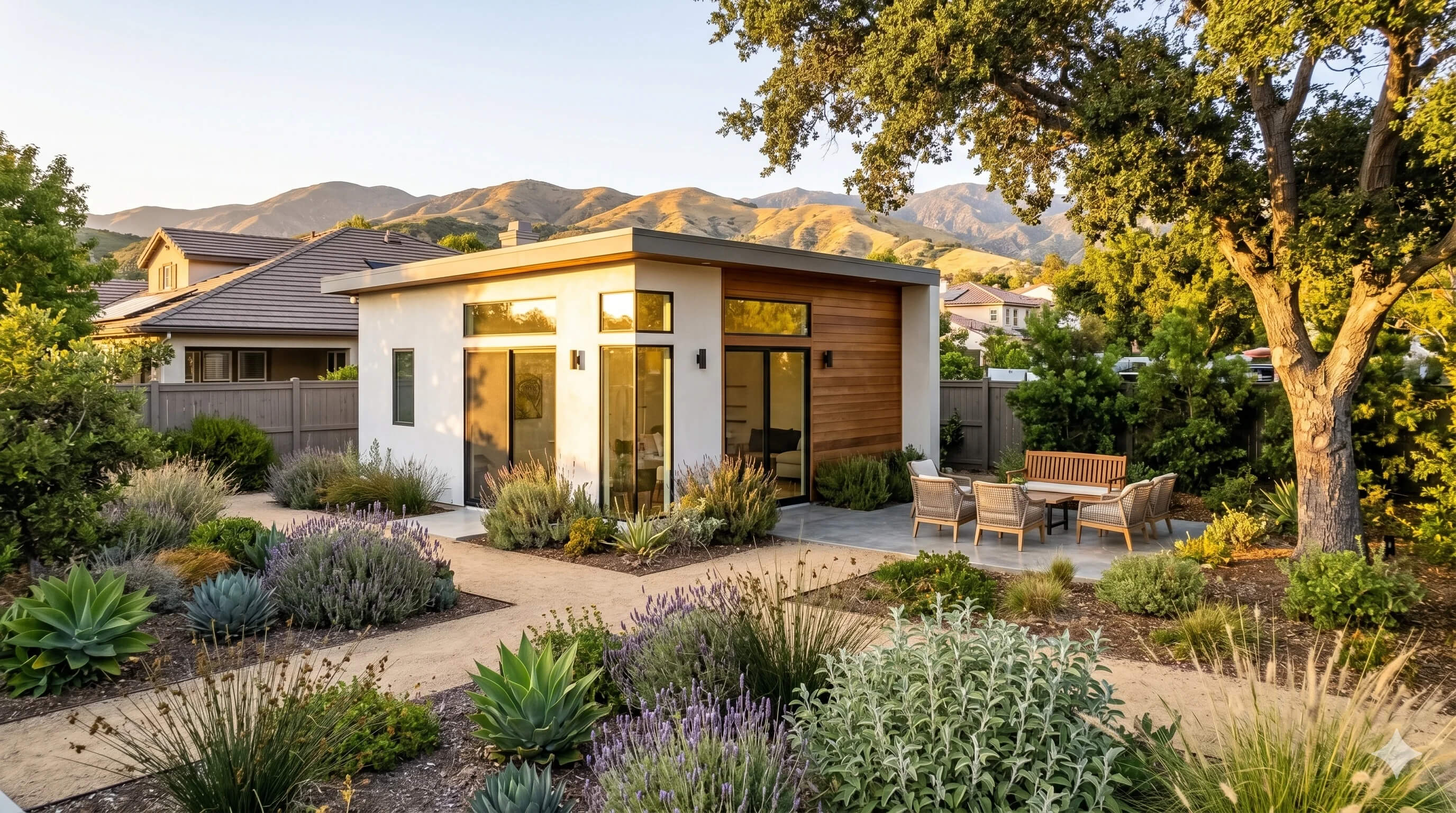
If you own a home in Diamond Bar, Walnut, Chino Hills, or anywhere in the East San Gabriel Valley, California just handed you one of the most valuable real estate opportunities in decades — and most homeowners don’t know it yet.
As of January 1, 2026, a series of new state laws have made building an Accessory Dwelling Unit (ADU) easier, faster, and more financially rewarding than ever before. Whether you want to generate rental income, house a family member, or increase your property value, the regulatory barriers that once made ADUs complicated have largely been removed.
This guide breaks down exactly what changed, what it means for you as a homeowner, and whether building an ADU makes sense for your specific situation.
2026 California ADU Rules at a Glance
| Rule in Effect for 2026 | What It Means for You |
|---|---|
| Standard ADU owner occupancy generally cannot be required (AB 976, eff. Jan 1, 2024) | Qualifying owners may build a standard ADU on a rental property without living there |
| New 15-business-day application completeness review (SB 543, eff. Jan 1, 2026) | Cities must quickly tell you exactly what is missing from your application |
| Completed applications generally require approval or denial within 60 days | Qualifying applications have a clearer review timeline; missed deadlines may trigger deemed approval |
| Pre-approved ADU plan programs required under AB 1332 | Walnut and Diamond Bar both offer local pre-approved plan resources that may shorten review |
| JADU owner-occupancy rule updated under AB 1154 | Owner-occupancy requirements only apply to JADUs that share sanitation facilities |
| Impact-fee protections for ADUs ≤750 sq ft and JADUs ≤500 sq ft | Smaller units are protected from impact fees; applies to impact fees, not all permit costs |
| Pre-2020 unpermitted ADUs may seek legalization under AB 2533 | Existing converted spaces may have a compliance pathway, subject to safety requirements |
What Is an ADU — And Why Should East San Gabriel Valley Homeowners Care?
An Accessory Dwelling Unit (ADU) is a secondary housing unit on a single-family property — commonly built as a detached backyard structure, a garage conversion, or an addition to the main home. A Junior ADU (JADU) is a smaller version (up to 500 sq ft) created entirely within the existing home’s footprint.
In the East San Gabriel Valley, ADUs have become one of the most talked-about real estate strategies for a simple reason: the region has a deep housing shortage, strong rental demand, and a large multi-generational population that values having extended family on the same property. Add in home prices that have risen significantly over the past decade, and ADUs represent a way to generate real cash flow from an asset you already own.
Quick Answer
If you are buying a home with an existing unpermitted ADU, see our guide on the risks of buying homes with unpermitted ADUs in Southern California before making an offer.
California ADU rules in effect for 2026 give homeowners in Walnut, Diamond Bar, Chino Hills, Rowland Heights, Brea, Yorba Linda, and nearby communities clearer application timelines and more options for creating or legalizing accessory dwelling units. Key 2026 updates include a required 15-business-day application completeness determination, updated JADU owner-occupancy rules, and stronger enforcement when local ADU ordinances conflict with state law. Standard ADU owner-occupancy restrictions were removed under AB 976 effective January 1, 2024.
Here’s the key shift: until recently, building one was complicated. Permitting was slow, local agencies applied inconsistent rules, and owner-occupancy requirements added restrictions. The 2025 and 2026 law changes eliminated most of those obstacles — and the financial case for building an ADU in the San Gabriel Valley has never been stronger.
The 2026 ADU Law Changes — What Actually Changed and What It Means for You

1. Owner-Occupancy Requirements Are Gone (AB 976 — Effective January 1, 2024)
What the law says: AB 976 eliminated the requirement that a property owner must live on-site to build or rent out an ADU on their single-family property.
What it means for you: If you own a rental property or investment property in the San Gabriel Valley, you can now build an ADU on it without being required to live there yourself. This is a massive change for investors and landlords who want to add income-producing units to their existing portfolio without changing their living situation.
Note: Owner-occupancy requirements still apply to Junior ADUs (JADUs) that share bathroom facilities with the main home — but AB 1154 (effective January 1, 2026) limits when local agencies can impose even those conditions.
2. Completed ADU Applications Must Generally Be Approved or Denied Within 60 Days
What the law says: Local agencies are required to approve or deny ADU permit applications within 60 days. If they use pre-approved ADU plans, that timeline can be as short as 21–30 days in practice. If the agency misses the deadline, the permit is considered approved by default.
What it means for you: The days of ADU permits sitting in city review for 6 to 12 months are over — at least on paper. For homeowners in Diamond Bar, Walnut, and Chino Hills, this means you can now plan your build timeline with much more certainty. City delays can no longer indefinitely block your project.
3. Local Agencies That Block ADUs Now Face Automatic Consequences (SB 9, SB 543)
What the law says: Any local ADU or JADU ordinance not submitted to the California Department of Housing and Community Development (HCD) within 60 days of adoption is automatically void. If a city does not comply with HCD findings within 30 days, their ordinance is also voided — and the state’s more permissive default rules apply instead.
What it means for you: Cities can no longer quietly adopt local rules that are stricter than state law without consequence. If your city has been blocking or discouraging ADU projects, those local restrictions are now more likely to be challenged and overridden. This levels the playing field significantly for San Gabriel Valley homeowners.
4. No Impact Fees on Smaller ADUs (Effective Statewide)
What the law says: No impact fees can be charged on JADUs up to 500 sq ft or ADUs up to 750 sq ft. ADUs and JADUs under 500 sq ft are also exempt from school impact fees. For larger ADUs, fees must be proportional to the primary dwelling’s square footage — not charged as if the ADU were a standalone new home.
What it means for you: Impact fees used to add $10,000 to $30,000+ to the cost of building an ADU in some cities. For smaller units — which are often the most practical and affordable option for San Gabriel Valley homeowners — those fees are gone entirely. This significantly improves your return on investment, especially for garage conversions and JADUs.
5. Unpermitted ADUs Can Now Be Legalized (AB 2533)
What the law says: AB 2533 created a clear pathway to legalize ADUs and JADUs built before January 1, 2020 without facing major penalties.
What it means for you: A significant number of San Gabriel Valley homes — particularly older properties in Diamond Bar, Walnut, and Rowland Heights — have informal “bonus rooms,” converted garages, or detached structures that were never permitted as ADUs. You can now legalize these units, add them to your legal rental inventory, and benefit from their full rental and resale value. This is a significant opportunity for homeowners who have been quietly renting these spaces or simply leaving them unused.
6. Coastal and Disaster Zone Approvals Streamlined (AB 462)
What the law says: AB 462 (effective October 15, 2025) streamlines coastal development permit approvals for ADUs in the coastal zone.
What it means for you: Less relevant for inland San Gabriel Valley properties, but relevant for those in Orange County communities like Brea and Yorba Linda near coastal commission jurisdiction.
The Financial Case for Building an ADU in the East San Gabriel Valley — 2026 Numbers
Understanding the law changes is step one. Understanding the numbers is what drives the decision.
What Does It Cost to Build an ADU in the San Gabriel Valley?
| ADU Type | Cost (2026) | Monthly Rent (San Gabriel Valley and Orange County) | Impact Fees |
|---|---|---|---|
| JADU (up to 500 sq ft) | $50k – $100k | $1,400 – $1,800 | None ✓ |
| Garage Conversion (350–500 sq ft) | $80k – $150k | $1,400 – $1,800 | None ✓ |
| Attached Addition (400–700 sq ft) | $120k – $200k | $1,800 – $2,400 | Proportional |
| Detached ADU (600–1,000 sq ft) | $200k – $350k+ | $2,200 – $3,000 | Proportional |
2026 estimates for the East San Gabriel Valley, Chino Valley & North Orange County market. Sources: BFPM, CALI ADU, ADU West Coast.
The cost breakdown table above summarizes typical 2026 ranges for each ADU type. Garage conversions and JADUs offer the strongest cost efficiency and are fully exempt from impact fees under current state law.
Permit and plan-check costs vary by city and project type. California law provides important protections against certain impact fees specifically — not all permit costs or plan-check fees. The City of Walnut, for example, publishes a plan review cost of approximately $3,374 for its pre-approved ADU program. Always obtain city-specific fee estimates before budgeting.
What Can You Rent an ADU for in the San Gabriel Valley?
Based on current rental data for the East San Gabriel Valley and surrounding communities:
At $2,000/month, a 1-bedroom ADU generates $24,000 per year in gross rental income. At $2,500/month, that’s $30,000 per year — before expenses.
What Is the Return on Investment?
Using a realistic San Gabriel Valley example:
- Cost to build a detached 1-bedroom ADU: $250,000
- Monthly rent: $2,200
- Annual gross income: $26,400
- Annual ROI: approximately 8–10%
- Break-even timeline: 6–8 years
- Property value increase: $150,000–$300,000+ added to your home’s resale value
For a garage conversion at $120,000 with rent of $1,800/month ($21,600/year), the gross annual yield is approximately 18% and the gross payback period is approximately 5.6 years before expenses. These are among the best real estate returns available to San Gabriel Valley homeowners without purchasing a separate property.
Find Out What Your Home Is Worth — and What You’ll Actually Walk Away With
Get your free home valuation instantly. No obligation, no pressure — just a straight answer so you can make an informed decision before you list.
Who Should Seriously Consider Building an ADU Right Now?
Multi-generational families. This is the most common use case in Diamond Bar, Walnut, and Chino Hills. An ADU provides a private, legal living space for aging parents, adult children, or in-laws — on the same property, with the privacy and dignity that a separate unit provides. The 2026 law changes mean you no longer need to live on-site yourself to make this work if you own a second property.
Homeowners who want passive income without buying another property. With interest rates still elevated and San Gabriel Valley home prices above $1M in most neighborhoods, buying a second rental property requires significant capital and carries substantial debt. Building an ADU on a property you already own is a lower-risk way to generate rental income using existing equity — often through a HELOC or cash-out refinance rather than a new purchase loan.
Landlords with existing rental properties. Now that owner-occupancy requirements are eliminated for standard ADUs, investors who own single-family rentals in the San Gabriel Valley can add a second unit to the same lot — effectively doubling the income-producing potential of that asset without purchasing additional land.
Homeowners with unpermitted structures. If you have a converted garage, a detached room, or any structure being used as living space that was built before January 1, 2020 and is not currently permitted as an ADU, AB 2533 gives you a clear and penalty-reduced path to legalization. Legalizing a qualifying unpermitted ADU may improve your property’s marketability and may generate legal rental income, though results depend on the unit’s condition, required corrections, and local market conditions.
Long-term homeowners thinking about retirement. An ADU can serve as a long-term income source in retirement, or as a way to house a caregiver on-site as health needs evolve. For homeowners in their 50s and 60s who have significant equity in their San Gabriel Valley homes, an ADU is often a more effective wealth strategy than moving or downsizing.
What to Think Through Before You Build

The law changes are favorable, but building an ADU is still a significant project that requires careful planning. A few things every San Gabriel Valley homeowner should evaluate before moving forward:
Lot size and setbacks. Most San Gabriel Valley single-family lots can accommodate an ADU, but setback requirements, lot coverage limits, and utility easements all affect what you can build where. A site assessment early in the process prevents costly surprises later.
Financing. Common options include a HELOC, cash-out refinance, construction loan, or ADU-specific loan programs. At current interest rates, many homeowners find that a garage conversion or JADU — with lower construction costs and zero impact fees — offers the strongest cash-on-cash return while keeping financing manageable.
AB 1482 and local rent control. If you plan to rent your ADU, understand that California’s Tenant Protection Act (AB 1482) applies to ADUs over 15 years old just as it applies to other rental units. New ADUs are exempt from rent caps for the first 15 years — one more advantage of building new.
Property tax implications. Adding an ADU typically results in a supplemental property tax assessment on the value of the new construction — but your existing home’s assessed value is not re-assessed. The net increase in annual property taxes is usually well below the monthly rental income the ADU generates.
Contractor selection. ADU construction quality varies widely. Work with licensed contractors who have completed ADU projects in your specific city — permitting requirements and inspector expectations differ between Diamond Bar, Walnut, Chino Hills, and adjacent municipalities.
Bottom Line: Is This the Right Move for You?
California’s 2026 ADU law changes are the most significant loosening of housing restrictions in the state’s history. For San Gabriel Valley homeowners, the combination of eliminated owner-occupancy requirements, faster permitting, removed impact fees, and a clear legalization path for unpermitted structures creates a genuine window of opportunity.
An ADU is not the right move for every homeowner — it requires capital, planning, and a realistic understanding of the rental market. But for the right property and the right situation, it is one of the best ways to generate income, build long-term wealth, and add flexibility to your housing situation without selling or moving.
If you’re thinking about whether an ADU makes sense for your specific property — in Diamond Bar (91765), Walnut (91789), Chino Hills (91709), Rowland Heights (91748), Hacienda Heights (91745), West Covina (91791), Chino (91710), Brea (92821), Fullerton (92831), Yorba Linda (92886), or anywhere across the East San Gabriel Valley, Chino Valley, or North Orange County — I’m happy to walk through the numbers with you. No obligation, just a straight conversation about what’s realistic.
📞 Call or text: 909.610.5188
📅 Book a free 15-minute call: calendly.com/jackmarealestate/book-a-15-minutes-call
🌐 Learn more: jackmarealestate.com
Frequently Asked Questions — ADU Laws in California 2026
Can I build an ADU in Diamond Bar, Walnut, or Chino Hills?
Yes. All three cities are subject to California state ADU law, which overrides most local restrictions. As of 2026, state law requires cities to approve compliant ADU applications within 60 days, and local ordinances that conflict with state standards are automatically void. Diamond Bar, Walnut, and Chino Hills all allow ADUs on single-family residential lots under state guidelines.
Do I have to live on my property to build an ADU in California?
No. AB 976, effective January 1, 2024, eliminated owner-occupancy requirements for standard ADUs statewide. You do not need to live on the property to build or rent out an ADU. Owner-occupancy rules still apply to Junior ADUs (JADUs) that share bathroom facilities with the main home, but AB 1154 (effective January 1, 2026) limits when local agencies can impose even those conditions.
How long does it take to get an ADU permit in California in 2026?
California State ADU Law generally requires a permitting agency to approve or deny a completed ADU or JADU application within 60 days. If the agency does not act within that period, the application may be deemed approved under state law. Separately, AB 1332 requires cities to establish pre-approved ADU plan programs, which can shorten review to 21–30 days. Both the City of Walnut and City of Diamond Bar have official pre-approved ADU plan programs under AB 1332.
🏠 Local Resource: Pre-Approved ADU Plans in Your CityCity of Walnut — Offers a pre-approved ADU plan program under AB 1332, with over-the-counter planning review for eligible projects. Published plan review cost: approximately $3,374. Walnut ADU Info →
City of Diamond Bar — Pre-approved ADU plans under AB 1332 bypass pre-screening and go directly to plan check. Diamond Bar ADU Info →
City of Chino Hills — ADU rentals must be at least 31 days under local ordinance. Chino Hills ADU Info →
Can I build an ADU on a rental property I do not live in?
Yes. Since AB 976 eliminated owner-occupancy requirements for standard ADUs, you can build an ADU on a single-family rental property you own without living there yourself. This is a significant opportunity for investors and landlords in the San Gabriel Valley who want to add a second income-producing unit to an existing rental property.
What is the difference between an ADU and a JADU?
An ADU (Accessory Dwelling Unit) is a full secondary housing unit — detached, attached, or a converted garage — up to 1,200 sq ft under state law. A JADU (Junior ADU) is smaller — up to 500 sq ft — created entirely within the existing home’s footprint. JADUs are cheaper to build, exempt from impact fees, and a practical option for homeowners wanting rental income with minimal construction. The trade-off is that JADUs sharing bathroom facilities may still have owner-occupancy requirements under local rules.
Will building an ADU increase my property taxes?
Building an ADU will result in a supplemental property tax assessment on the new construction value only — your existing home’s Proposition 13 assessed value is not re-assessed. The annual property tax increase is typically well below the rental income the ADU generates. For example, a $250,000 ADU might add $2,500 to $3,000 per year in taxes while generating $24,000 to $30,000 per year in rental income.
Can I rent out my ADU immediately after it is built?
Yes, once your ADU receives final inspection approval and a certificate of occupancy, you can rent it immediately. JADUs may not be used as short-term rentals and must be rented for terms longer than 30 days under California law. Standard ADU rental-term rules may also be restricted by local ordinance. Chino Hills, for example, requires ADU rentals to be at least 31 days. Confirm the applicable rules with your city before advertising any ADU for rent.
What is the minimum lot size for an ADU in California?
California state law does not impose a minimum lot size requirement for ADUs. Cities cannot deny an ADU application solely on lot size if the proposed unit meets state setback, height, and coverage standards. Most San Gabriel Valley single-family lots can accommodate at least a JADU or garage conversion. A site feasibility review with a contractor or architect is the best way to assess your specific property.
Can I legalize an unpermitted ADU in California?
Yes. AB 2533, effective January 1, 2025, created a clear pathway to legalize ADUs and JADUs built before January 1, 2020 without major penalties. If you have an unpermitted converted garage, detached room, or informal second unit on your property built before that date, you can now apply to have it permitted as a legal ADU — increasing your home’s value, establishing legal rental income, and eliminating liability risks associated with unpermitted construction.
Is an ADU subject to California AB 1482 rent control?
It depends on age. California’s Tenant Protection Act (AB 1482) applies to rental units more than 15 years old. A newly built ADU is exempt from AB 1482 rent caps for the first 15 years — meaning you can charge and adjust market rent freely during that window. After 15 years, AB 1482 applies and annual rent increases are capped at 5% plus CPI (max 10%). This is another financial advantage of building new over renting an older unpermitted structure.
Want to Know If Your Lot Qualifies for an ADU?
Every property is different. Lot size, setbacks, existing structures, and city rules all affect what you can build. I offer a free, no-obligation Property & Lot Assessment for homeowners across the East San Gabriel Valley, Chino Valley, and North Orange County — including Diamond Bar, Walnut, Chino Hills, Rowland Heights, Hacienda Heights, West Covina, Brea, Fullerton, and Yorba Linda.
📞 Call or text: 909.610.5188 | 📅 Book a free 15-min call: Schedule here
Official Sources & Local Resources
- California Department of Housing and Community Development, Accessory Dwelling Unit Handbook, updated March 2026
- California Government Code Sections 66310–66342 (State ADU Law)
- California Civil Code Section 1947.12 (AB 1482 rent-cap provisions and exemptions)
- City of Walnut — ADU & Pre-Approved ADU Information
- City of Diamond Bar — Accessory Dwelling Units
- City of Chino Hills — Accessory Dwelling Units
- California State Board of Equalization — New Construction Property Assessment
Disclaimer: This post is for general informational purposes only and does not constitute legal, tax, or financial advice. ADU rules, fees, and requirements vary by city and property. Always consult a licensed contractor, attorney, and tax advisor before beginning any construction project. Jack Ma | REALTOR® | DRE #01869426 | Century 21 Masters
For sellers thinking through the financial side of listing their home, understanding California real estate capital gains tax in 2026 is an important part of planning your net proceeds before you list.
📋 Get Your Free Seller Net Sheet
See exactly what you’ll walk away with after commission, closing costs, and taxes — before you decide to list.
Takes 60 seconds. No obligation. No pressure.
Jack Ma | REALTOR® | DRE #01869426 | Century 21 Masters | 909.610.5188
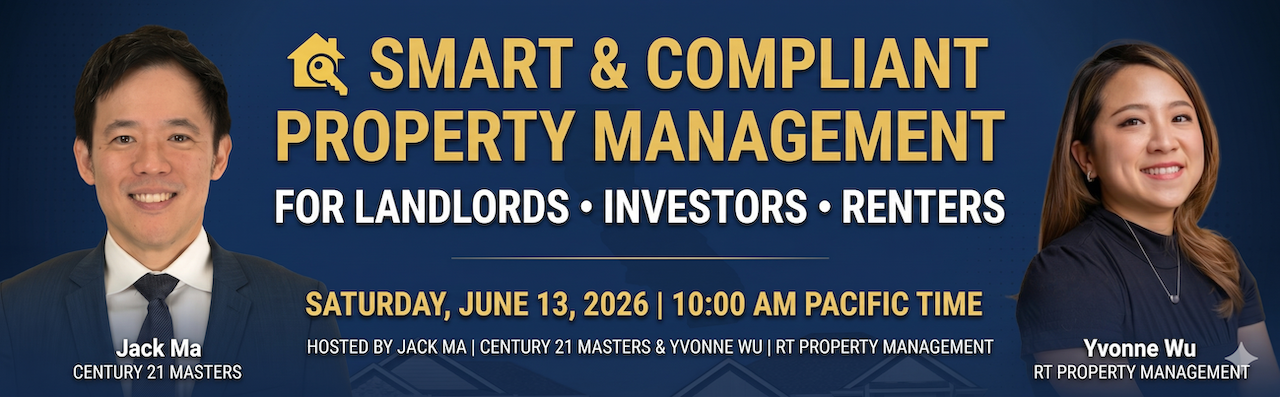
Free Live Zoom Webinar — June 13, 2026
Smart & Compliant Property Management
For Landlords • Investors • Renters
Hosted by Jack Ma (Century 21 Masters) & Yvonne Wu (RT Property Management)
Saturday, June 13, 2026 | 10:00 AM Pacific Time
Space is limited. Register now to secure your spot.