

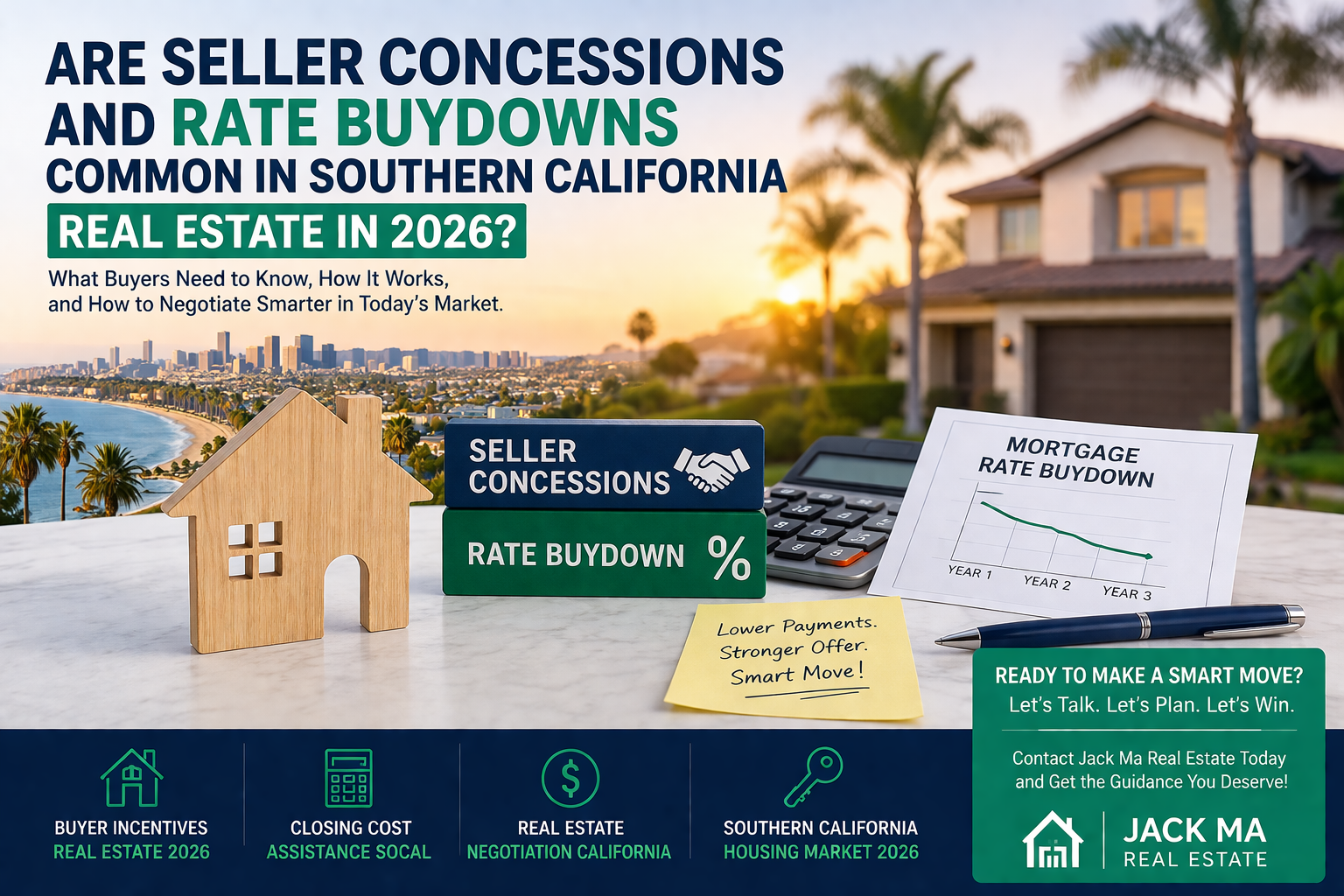
The Southern California housing market in 2026 is more balanced than a few years ago. Prices remain high, inventory is slowly rising, and interest rates are higher than in the boom years. This has given buyers more negotiating power and prompted sellers to offer creative incentives. In major SoCal markets like Los Angeles, San Diego, and Orange County, a large share of recent home sales has involved seller concessions, credits, or perks that make a deal easier to close. Likewise, mortgage rate buydowns (where the seller or builder pays to lower the buyer’s interest rate for a time) have become increasingly popular as buyer incentives in 2026. This article explores how common these trends are in Southern California and what they mean for buyers and sellers.
Why the Southern California Housing Market Is Shifting in 2026
After years of frenzied competition (bidding wars and all-cash offers), the SoCal market is settling into a more strategic phase. Demand still exceeds supply in many coastal and inland areas. High job growth and population keep prices relatively high, but homes are sitting on the market longer and buyers are becoming choosier. For example, in much of Los Angeles and Ventura County, well-priced move-in-ready homes still sell quickly, but “overpriced properties are sitting” and “buyers are negotiating more” than they were in 2021–2022.
This shift means buyers have more leverage than in the last few years, but sellers still hold power if they price smartly and market well. National data show buyer financing is normalizing: in Q1 2025, sellers provided concessions in 44% of U.S. transactions, and SoCal markets like San Diego (60.7%), Los Angeles (56.1%), and Riverside (51.2%) were among those with the highest concession rates. In practical terms, Southern California in 2026 is a segmented, data-driven market, not an outright crash or boom. Both buyers and sellers now need preparation and realistic expectations to succeed.
What Are Seller Concessions and Why Are They Rising?
Seller concessions are credits or discounts that the seller agrees to give the buyer to help close the deal. Common concessions include paying part of the buyer’s closing costs, offering credit for repairs, or even covering points to buy down the interest rate. These concessions “help attract buyers who might be weighing upfront cash needed” and make homes more affordable in a high-cost area.
In Southern California today, seller concessions are much more common than they were a few years ago. For example, one analysis found that in January 2026, about 21% of home sales in Moreno Valley (Inland Empire) included seller concessions, averaging around $6,500 per transaction. In the same period, median sale prices held steady, so sellers were able to offer credits without deeply cutting their bottom line. On a larger scale, markets with the highest national concession rates include SoCal hot spots: San Diego (60.7%) and Los Angeles (56.1%) for Q1 2025. These figures show that more than half of recent SoCal sales involve some seller credit, a clear power shift toward buyers.
Why the rise? Simply put, with higher mortgage rates, some buyers feel “priced out” and need help. Sellers who still want to close deals use concessions to bridge that gap. As one analysis put it, "Successful sellers recognize a key distinction: a price cut is perceived as a loss, while a concession is viewed as a deal-closer." In practice, offering, say, a $7,000 closing-cost credit lets a seller keep their sale price strong while giving the buyer needed cash. Concessions don’t inflate the sale price and can be written as credits on the closing statement.
Rate Buydowns: How They Work and Why They’re Gaining Traction
A mortgage rate buydown is a form of seller concession where the seller (or builder, or lender) pays “points” up front to temporarily lower the buyer’s mortgage interest rate. In other words, the seller lends the buyer a short-term discount on the rate. There are two main types:
- Temporary buydown (e.g. 2-1 buydown): The interest rate is reduced for the first 1-2 years of the loan, then returns to normal. For example, a “2-1 buydown” might cut the rate by 2% in year 1 and 1% in year 2.
- Permanent buydown: The interest rate is lowered for the life of the loan, in exchange for more points paid at closing.
Temporary buydowns are popular in 2026 because they give new buyers breathing room when interest rates are relatively high. Builders and agents often offer them as incentives. Many new-home communities in Southern California, for example, advertise interest-rate buydowns or “buy down your rate” programs to attract buyers. The buyer gets lower payments initially (e.g. on a $750,000 home, the 1st-year payment might be based on ~4.5% instead of 6.5%), and the seller/builder pays the cost out of proceeds.
Who typically pays for the buydown? Often it’s the seller or builder as a selling concession. For example, real estate professionals note that many home builders are now offering rate buydowns and closing cost credits to move inventory. In resale deals, agents report that seller-paid buydowns have become more common, especially in markets where inventory is rising. The mortgage industry also supports this: a guide explains that in a softening market, sellers are motivated to offer concessions like buydowns to encourage buyers.
How it works in practice: At closing, a lender sets aside extra funds (from the seller’s contribution) to “buy down” the rate. If a 1-point buydown reduces the rate by ~0.25%, the seller might pay 3 points ($3,000 for each $100,000 financed) to cut a 6.5% rate to 4.5% for the first year. The loan then normalizes after the buydown period. The result is lower initial payments and faster qualification for the buyer, making it easier to get approved at a higher sale price. The seller benefits by widening the pool of qualified buyers and can often still get a strong price thanks to the concession.
In short, mortgage rate buydowns are on the rise in 2026. As one expert notes, “builder incentives remain aggressive,” with many including rate buydowns to boost sales. For buyers, understanding how rate buydowns work is key: it’s essentially a negotiated agreement (often written as a credit) that lowers your mortgage rate for the first few years, paid for by someone else.
Other Buyer Incentives and Closing-Cost Assistance
Rate buydowns and seller credits for repairs are just part of the bigger picture of buyer incentives in 2026. Both government and private programs have expanded to help affordability:
- Down payment and closing cost programs: In California, state and local agencies (like CalHFA, city housing departments, etc.) offer assistance grants and loans for first-time or income-qualified buyers. For example, the Mortgage Reports notes that many buyers don’t realize how “strong” down payment assistance programs have become, often at the state or municipal level. Programs like CalHFA’s silent-second loans or city grants can cover tens of thousands toward closing costs.
- Builder incentives: New home builders in SoCal are aggressively offering incentives. Common perks include rate buydowns, closing-cost credits, and even price reductions on new inventory. In the Instagram posts and news of 2026, homebuilders advertise “zero mortgage rate” programs or free upgrades, all essentially seller concessions built into the sale.
- Loan program innovations: Lenders have ramped up creative loan structures. Buyers are looking into assumable FHA or VA loans, lender-specific buydowns, and low-down-payment products like Fannie/Freddie 3%-down programs. These aren’t seller concessions per se, but they work similarly by reducing upfront cost or monthly payment burdens.
In summary, the trend in 2026 is that numerous incentives exist to help buyers. If you’re buying in Southern California, it’s worth exploring city grants for closing-cost assistance, asking builders about promotions, and asking your agent about special financing deals. All of these effectively act like seller concessions that reduce your out-of-pocket or financing cost.
Negotiation Tactics: Buyers Are Asking, Sellers Are Responding
The rise of concessions and buydowns is fundamentally a negotiation story. Buyers entering the 2026 market are more informed and prepared. They often start with a pre-approval and know exactly what they can afford. When submitting offers, these buyers frequently include requests for seller-paid costs or rate buydowns.
For sellers, this means deals are closing on “strategy” not “price hope.” As one market update bluntly states, “Today’s market favors negotiation and strategy over frenzy”. Instead of pricing at a frenzy-level high, sellers who want to sell must be open to concessions. Buyer agents often advise writing offers with smart contingencies and seller credits, rather than waiving everything to win. In fact, an agent observed that giving concessions (like covering some fees) can be more appealing than simply raising the price, because it shows flexibility.
Practical negotiation tips in SoCal 2026:
- Know current concession trends. In LA/Ventura, for example, skilled agents note “more inspection and appraisal negotiations” and “increased seller concessions” among savvy buyers.
- Bundle smart requests. Instead of demanding a price cut, buyers might ask the seller to pay a portion of the loan’s points (a buydown) or cover 2% of closing costs. These are requests that sellers can afford while staying close to list price.
- Keep it reasonable. Sellers will respond better if the requested concession aligns with market conditions. If homes are only moderately oversupplied, asking for every possible perk can backfire. Good agents often qualify the buyer’s financing firmly (so the seller isn’t nervous about credit) and then ask for a known amount in credits.
- Timing matters. As in any negotiation, timing requests are key. Many agents counsel initial offers without all concessions fully demanded, leaving room to ask for credits after appraisal or inspections. This way the seller already has a signed contract, and closing-cost negotiation looks more like a last-mile fix.
In short, real estate negotiation in California in 2026 is collaborative. Buyers ask for incentives that sellers can give, and most sellers know that offering something now can be the difference between selling or sitting. The market reward goes to parties who “play it smart," price correctly, market professionally, and are flexible on terms.
What This Means for Buyers and Sellers
Overall, the rise of seller concessions and rate buydowns signals a healthy cooling of the overheated market in Southern California. Here’s what it means for you:
- Buyers: You have options. Beyond just saving for a bigger down payment, look into every incentive available. Ask sellers and builders about closing-cost assistance and temporary rate buydowns, and leverage any local first-time buyer programs or grants. Remember that these are legal and common negotiation tools, not “some crazy ask"; in fact, surveys show well over half of homes are offering deals like credits or buydowns in SoCal. A smart agent will guide you on how to use these tactics without scaring off sellers.
- Sellers: Be realistic and prepared. Gone are the days when you could slap any price tag and expect a bidding war. Instead, focus on accurate pricing and highlight any added value of your home. If the market requires it, be ready to offer incentives. Even if you don’t “need” to, offering a $5,000 credit to help with a buyer's closing costs might get you $10,000 more in sale price or a faster close. In hot markets, zeroing in on motivated buyers (like first-timers) and sweetening the deal with buydowns or repairs can set your listing apart.
- The market: More concessions and buydowns mean smoother transactions at realistic prices. They help bridge the gap between what buyers can afford and what sellers want. Analysts note that this trend is a power shift toward negotiation: "Buyers have more leverage now than they’ve had in years." That doesn’t spell collapse; it means mid-2020s housing in SoCal rewards information and flexibility, not just huge cash offers.
Ready to Unlock Your Southern California Home?
If you’re looking to buy or sell in this evolving market, Jack Ma Real Estate is here to help. Our experienced team knows the ins and outs of SoCal neighborhoods and can guide you to smart deals. Whether you’re seeking the latest buyer incentives, needing advice on rate buydowns, or simply wanting to understand how to negotiate the best terms, we have the expertise to make your move smooth and successful.
Take the next step: Call Jack Ma Real Estate at 909-610-5188 or email [email protected] for a free consultation. Let us match you with programs, lenders, and negotiation strategies tailored to your situation. Your dream home (or the right offer on your home) is within reach; contact us today!
Frequently Asked Questions
Q1: Are seller concessions common in Southern California real estate in 2026?
Yes. Many deals now include concessions. Industry reports show over half of recent home sales in Los Angeles and San Diego have seller credits (for closing costs, repairs, etc.). In 2026, concessions are a normal part of negotiation, especially in “balanced” price ranges.
Q2: What is a mortgage rate buydown and how does it help me?
A rate buydown is when someone (the seller, builder, or lender) pays upfront to temporarily lower your mortgage interest rate. For example, a 2-1 buydown cuts 2% off your rate in year one and 1% in year two. This means lower initial payments, making homebuying more affordable. After the buydown period, the rate returns to normal. It’s essentially a seller concession that “buys” you cheaper interest for a while.
Q3: Can I negotiate sellers to pay some of my closing costs or mortgage points?
Absolutely. In fact, it’s very common now. Many buyers ask for closing-cost credits or seller-paid points to fund a rate buydown. Sellers often agree if the overall offer is strong. These forms of closing cost assistance are popular because they allow buyers to finance less and sellers to keep their asking price intact.
Q4: Will asking for concessions hurt my offer?
Not necessarily—if done wisely. Today’s buyers and sellers expect some negotiation. As long as your offer price and terms are strong, asking for reasonable seller credits or buydowns is standard practice. It helps if your financing is pre-approved and your agent justifies the request (showing market comps or explaining how the credit makes your offer competitive). In most cases, it will not make sellers “hate” your offer, and could even make your offer stand out as serious yet fair.
Q5: How do I find home buying incentives or assistance programs in Southern California?
Talk to your real estate agent and lender. They can point you to local programs (like CalHFA loans or city-run grants for first-time buyers) and tell you about new-build incentives. As of 2026, many first-time buyer and down payment assistance programs exist statewide. Also ask new-home sales offices about current promotions (rate buydowns, cash-back, etc.). Websites of city housing departments and the California Housing Finance Agency list available grants. A good agent will help uncover these “hidden” incentives so you can reduce your upfront costs and monthly payments.
Check out this article next