
Quick Summary — Foreclosures in 2026
- Foreclosure filings are up: 13% nationally from a year ago (ATTOM, August 2026) and about 13% in California in the first half of 2026.
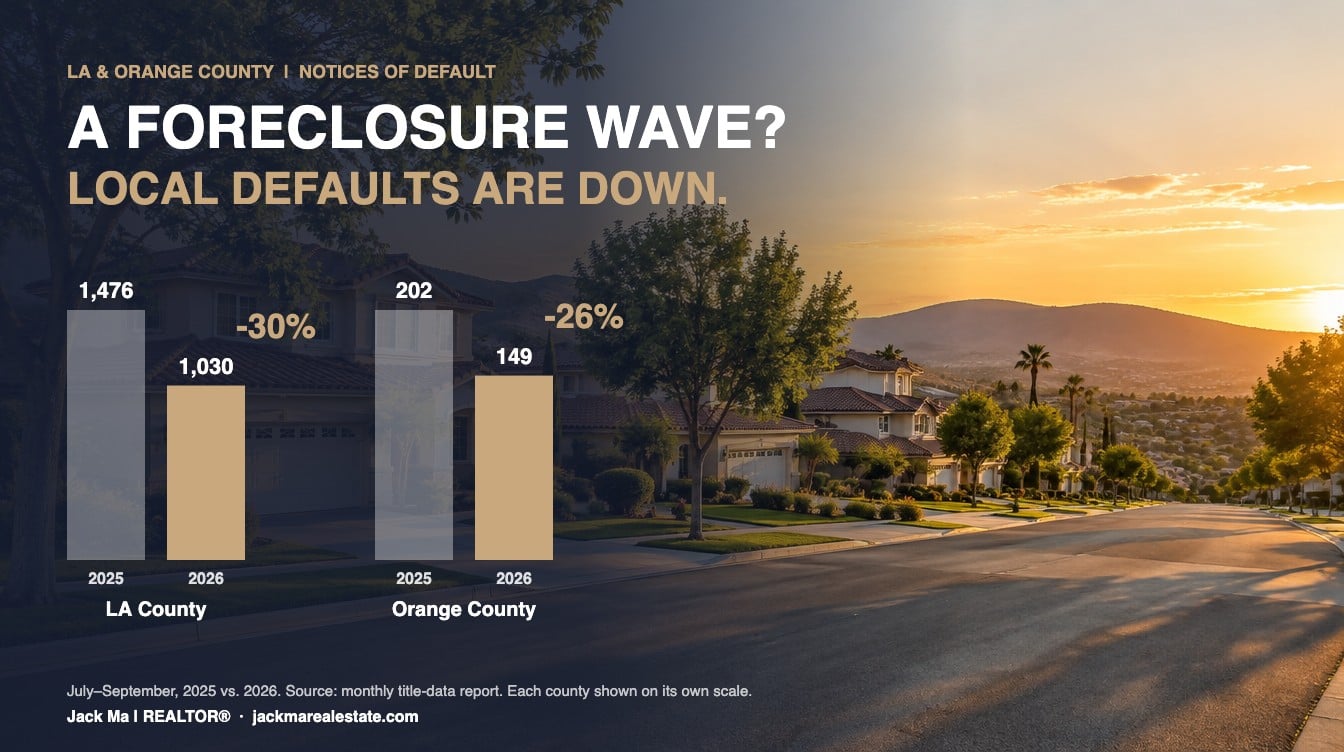
- Locally, it’s a different story: Notices of Default in LA and Orange County were about 30% lower this July through September than a year earlier.
- Most owners have real equity. The average California homeowner with a mortgage has about $623,000 (Cotality).
- The owners most at risk are recent buyers. Loans from 2022 or later make up nearly 35% of homes in active foreclosure (ICE).
- Bottom line: rising filings, yes. A 2008-style wave, no sign of it.
As of November 2026. Jack Ma | REALTOR® | DRE #01869426 | Century 21 Masters.
Lately I’ve been getting the same question from homeowners, past clients and even friends: “Jack, I keep seeing headlines about foreclosures going up. Is another 2008 coming?”
It’s a fair question. The headlines are real. But when you look past them, the picture is a lot calmer than the news makes it sound. Let me walk you through what’s actually happening, both nationally and right here in LA and Orange County.
Are foreclosures rising in California?
Yes, filings are up. Here’s what the national data shows:
- Nationally: 40,277 properties had a foreclosure filing in August 2026, up 13% from a year earlier (ATTOM).
- First half of 2026: 227,548 properties nationwide, up 21% from the first half of 2025 (ATTOM).
- California: 21,543 properties had a filing in the first half of 2026, up about 13%. That’s roughly 1 in every 680 homes (ATTOM).
So if someone tells you foreclosures are rising, they’re right. But “rising” and “a wave” are two very different things.
What’s happening with foreclosures in LA and Orange County?
This is where it gets interesting. I track the monthly number of Notices of Default (the first public step in a California foreclosure) filed in Los Angeles and Orange County. Here’s what this summer looked like compared with last year:
| Notices of Default | LA County 2025 | LA County 2026 | Orange County 2025 | Orange County 2026 |
|---|---|---|---|---|
| July | 544 | 363 | 113 | 60 |
| August | 473 | 307 | 64 | 43 |
| September | 459 | 360 | 25 | 46 |
| Total | 1,476 | 1,030 (−30%) | 202 | 149 (−26%) |
Monthly Notice of Default counts for LA and Orange County from a title-data report Jack receives. Monthly counts can move around, and September in Orange County was higher than a year earlier.
In other words, while filings are rising nationally and across California, defaults in LA and Orange County were about 30% lower this summer than last summer. To be fair, September in Orange County was up (46 vs. 25). But these are small numbers, and the three-month trend in both counties points down, not up.
Keep in mind that a Notice of Default doesn’t mean someone loses their home. Many owners catch up, work something out with their lender, or sell before it ever gets that far.
Is a foreclosure wave coming like 2008?
Based on today’s numbers, I don’t see one. Here’s why.
1. Foreclosure levels are still below normal
Even after this year’s increase, ATTOM says overall foreclosure activity “remains below pre-pandemic norms.” ICE reports that 0.53% of mortgages were in active foreclosure in mid-2026, still below the 0.57% level before COVID. The national delinquency rate was 3.55%, lower than the 4.16% of June 2019. Part of today’s increase is simply a return toward normal after several unusually quiet years.
2. Most owners have real equity
This is the biggest difference from 2008. Back then, millions of owners owed more than their homes were worth, so when they couldn’t pay, they had no way out.
Today, the average homeowner with a mortgage has about $310,000 in equity nationally and $623,000 in California (Cotality, Q2 2026). Only about 2% to 3% of mortgages are underwater, depending on how you measure it (Cotality and ATTOM).
Why does that matter? An owner with equity who runs into trouble can usually sell on the open market and walk away with money, instead of going through a foreclosure. That’s exactly what keeps a rise in filings from turning into a flood of distressed homes.
3. About half of mortgages carry rates under 4%
Roughly half of all U.S. mortgages had rates below 4% in late 2025, according to FHFA data reported by Wolf Street. With today’s rates above 7% (Freddie Mac’s average was 7.32% on October 22, 2026), those owners have very low payments compared with what it would cost to rent or buy again. That makes them far less likely to fall behind.
Who is really at risk of foreclosure or a short sale?
The pressure is concentrated in one group: people who bought in roughly the last two to four years.
- Loans originated in 2022 or later make up nearly 35% of homes in active foreclosure (ICE). These are owners who bought at higher rates and have seen limited price growth since.
- Many bought with small down payments, at higher rates, near the price peak. Buyers from 2020 hold about $86,000 more equity than buyers from 2023 (Cotality).
- Since then, property taxes, insurance and, for condo owners, HOA dues have kept climbing.
If one of these owners loses a job or faces a big expense, there may not be enough equity to sell for a profit after closing costs. That’s when a short sale, or in some cases a foreclosure, becomes possible.
I recently helped a family in that situation close a short sale in La Habra. You can read how that short sale came together, and why starting early made the difference.
But here’s the key point: this group is a small part of the overall market. Most owners in Diamond Bar, Chino Hills, Walnut, Brea and Yorba Linda have owned for years and have meaningful equity.
Will home prices drop if foreclosures rise?
A small rise in foreclosures usually doesn’t move prices much on its own. Prices fall hard when lots of distressed homes hit the market at once, and that’s not what the data shows today. Where you may see softness is in specific segments, like condos with HOA challenges or areas with many recent buyers. I wrote more about the outlook in Will Home Prices Drop in 2027? As always, no one can predict prices with certainty.
What should I do if I’m falling behind on my mortgage?
If you’re feeling pressure, the most important thing is to act early. In my experience, the earlier you look at your options, the more of them you have.
- Call your lender before you fall further behind. Ask about repayment plans, modifications or forbearance.
- Talk with a HUD-approved housing counselor. Their help is free.
- Find out what your home is worth today. If you have equity, selling on the open market usually protects far more of it than waiting.
- If you owe more than the home is worth, ask about a short sale. It requires lender approval and takes time, so starting early matters.
I’m not a lender, attorney or tax advisor. For questions about your loan, your legal rights or tax consequences, please talk with those professionals. I’m glad to help with the real estate side.
What Is Your Home Worth Right Now?
Free home valuation based on current sold comparables, not active list prices.
Free — Confidential — No Obligation
Feeling Pressure on Your Home? Let’s Look at Your Options
A calm, confidential 15-minute conversation about your home, your equity and your timing. English or Mandarin.
Book a Free 15-Min Call
909.610.5188
Jack Ma | REALTOR® | DRE #01869426 | Century 21 Masters | Diamond Bar · Walnut · Chino Hills · Chino · Brea · Yorba Linda
Frequently asked questions
Are foreclosures rising in California?
Yes, statewide filings are up. ATTOM reported 21,543 California properties with foreclosure filings in the first half of 2026, up about 13% from a year earlier. But in Los Angeles and Orange County, Notice of Default filings from July through September 2026 were about 30% lower than the same months in 2025, and national foreclosure activity remains below pre-pandemic norms.
Is a foreclosure wave coming like 2008?
Current data does not point to a 2008-style wave. Most homeowners with a mortgage have substantial equity (Cotality puts the average at about $310,000 nationally and $623,000 in California), and only about 2 to 3 percent of mortgages are underwater. Owners with equity can usually sell on the open market instead of losing the home. No one can predict the future with certainty.
Who is most at risk of foreclosure right now?
Recent buyers are overrepresented. According to ICE, loans originated in 2022 or later make up nearly 35% of homes in active foreclosure. Many of these owners bought with small down payments at higher rates and have seen little price growth, so they have less equity to fall back on if their income or costs change.
What is a Notice of Default in California?
A Notice of Default is generally the first public step in a California non-judicial foreclosure, recorded after a borrower falls behind. It does not mean the home will be lost. Many owners catch up, work out a modification with their lender, or sell before a sale date is set. A lender, HUD-approved housing counselor or attorney can explain the specific timeline.
What is the difference between a foreclosure and a short sale?
In a foreclosure, the lender takes back and sells the home. In a short sale, the owner sells on the open market for less than what is owed, with the lender’s approval. A short sale is usually an option only when there is little or no equity, and it requires lender approval. Credit and tax effects vary, so owners should speak with their lender and a qualified tax professional. See our La Habra short sale case study.
What should I do if I am falling behind on my mortgage?
Act early. Call your lender before you miss more payments, consider a free HUD-approved housing counselor, and find out what your home is worth today. If you have equity, selling on the open market usually protects far more of it than waiting until a foreclosure sale.
Related Reading
About Jack Ma — REALTOR® | DRE #01869426
Jack Ma is a licensed Broker Associate with Century 21 Masters (DRE #01869426) with 15+ years serving the tri-county border area of Los Angeles, Orange, and San Bernardino County. 300+ homes sold. Specializing in Diamond Bar, Walnut, Chino Hills, Chino, Brea, Yorba Linda, and Rowland Heights. Bilingual English and Mandarin. 909.610.5188 | [email protected]
Disclaimer: This article is for general informational purposes only and is not legal, tax, lending or financial advice. Sources: ATTOM foreclosure reports (August 2026 and mid-year 2026) and Q2 2026 home equity report; Cotality Q2 2026 home equity report; ICE Mortgage Monitor as reported by HousingWire (August 2026); FHFA data as reported by Wolf Street (January 2026); Freddie Mac PMMS. LA and Orange County Notice of Default counts are from a monthly title-data report and may be revised. If you are behind on payments, please contact your lender, a HUD-approved housing counselor, or a qualified attorney. No outcome or price is guaranteed.