

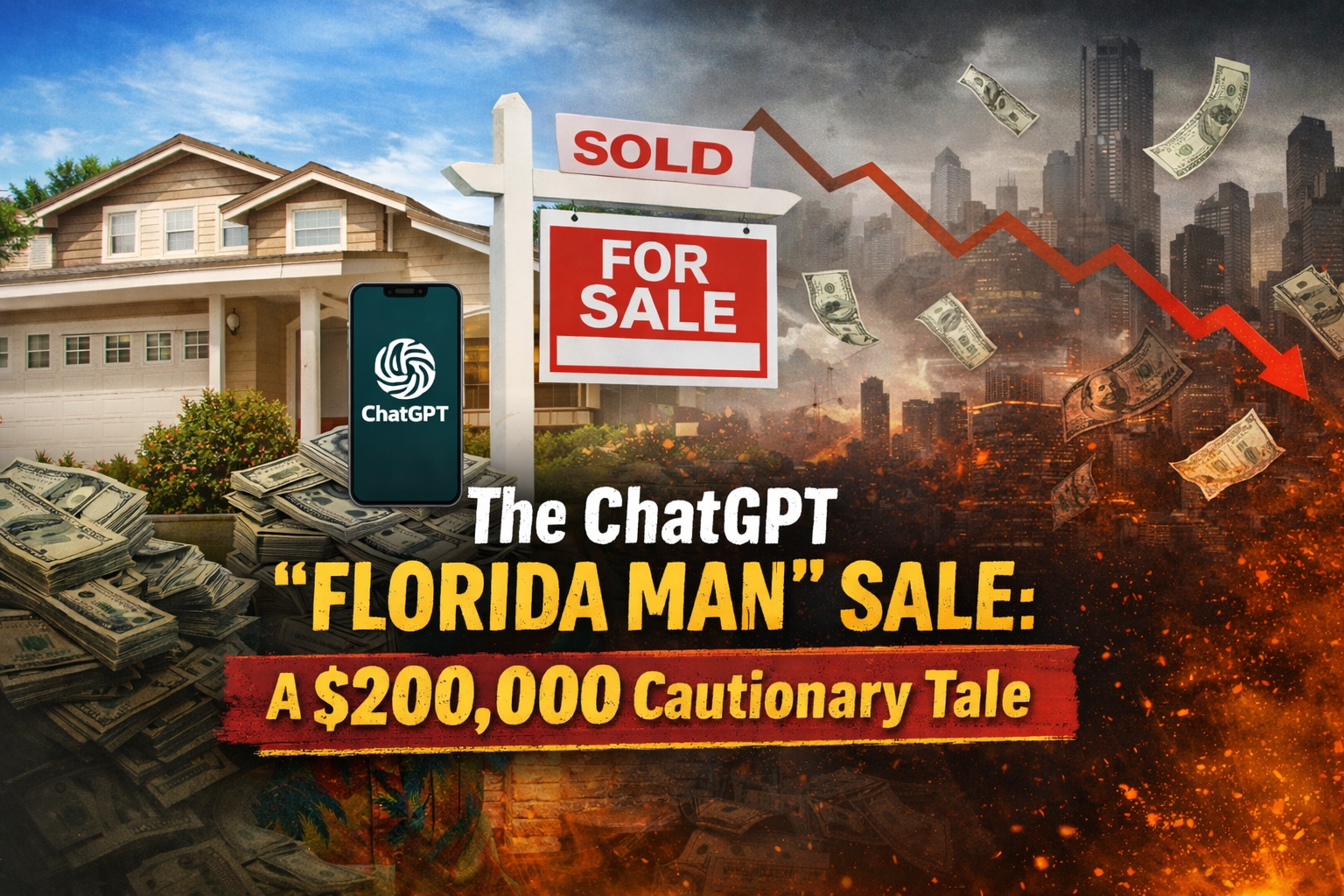
When a Florida homeowner let ChatGPT guide his sale, the headlines screamed, “$100K over asking!" ”. It sounds like a win, but savvy agents saw warning signs. In reality, experts estimate he left $75K–$225K on the table by skipping a pro. ChatGPT is a helpful assistant, but it can’t hunt down top dollar like an aggressive agent. One Realtor.com analysis shows that selling without a skilled agent often costs sellers big money. In short, relying on AI alone is an expensive shortcut in a field that rewards strategy and experience.
Viral Headline vs. Expert Reality

Press stories made it seem easy: ask ChatGPT, list high, and sell quick. In Florida, Robert Levine did just that. His home sold for $954,800, about $100K above what local agents had estimated. He avoided paying a listing commission (around $28K), which seemed like a win. But digging deeper, real estate pros point out the unseen costs. Allaire Conte at Realtor.com notes that without an agent’s guidance Levine likely lost $75K–$225K in potential profit. This gap comes after accounting for his commission savings and reflects what similar homes fetched on the market.
Why so much left behind? In a nutshell: ChatGPT played “passive librarian” with data, while top agents play “hunter.” A chatbot can regurgitate general advice, but it can’t network, analyze local buyer psychology on the fly, or push multiple bidders higher. Levine’s story is instructive: yes, his sale beat the average agent’s lowball. But a veteran Realtor with 17+ years of experience reads contracts and people. They know tactics to squeeze extra value from appraisal gaps, buyer agents, and competing offers. By contrast, Levine simply picked the highest offer out of five. An algorithm did no better than copying the top bid, letting plenty of extra equity slip through his fingers.
Now let’s break down what smart sellers do differently.
1. Maximum Market Saturation: Find the Emotional Buyer
Effective real estate marketing strategy in California (or anywhere) starts with visibility. We overwhelm the market with your listing until a motivated buyer bites. That means stunning videos, top placement, and broad reach.
Video Domination: Words and photos scroll by. Video stops, thumbs up. For example, Howard Hanna’s marketing team reports that listings with video content get 403% more inquiries than those without. Video tours let buyers feel your home’s flow and emotion, something still photos can’t do. Buyers spend longer watching video walkthroughs, which keeps your home top of mind and converts curiosity into offers. Even virtual reality tours have proven power: a University of Texas-Dallas found that VR tours cut the average days on market roughly in half (from 34 days to 19 days). Shorter time on market usually means a faster sale at a stronger price.
Zillow & Listings: Leveraging Zillow is key in Irvine’s competitive scene. Zillow’s new tools, Preview and Showcase, can build buzz before and during a listing. Preview lets agents share your listing with Zillow’s 235 million monthly visitors before it even hits the MLS, creating a head start on demand. When the house officially lists, Showcase kicks in: it offers high-res photos, 3D tours, and floor plans. Zillow’s data shows Showcase listings get twice the impressions and clicks of standard ones. Even more, homes using Showcase+3D tours score 75% more page views, saves, and shares than comparable homes without them. In practice, that means more eyeballs on your price tag and more competing buyers calling your agent.
Digital Blitz: Beyond Zillow, we flood all channels. Our campaigns (SEO, social ads, email blasts, etc.) reached 300,000 impressions in 90 days on a recent Irvine case, connecting your home to a high-traffic buyer pool. We craft catchy listing titles and clear, benefit-driven descriptions to stop scrollers. We stage social media reels and targeted ads to find the emotional buyer, the one who loves your home’s story. In short, we leave no stone unturned. By the time Open House hits, tens of thousands already know your address.
2. Total Transparency & The Interest “Firewall”
In our playbook, transparency doesn’t just build trust with buyers, it arms us with data to sell smarter. While other agents hope for the best, we track everything.
Interest Tracking: We log every click, report download, and saved listing. This “firewall” of data shows us which agents and buyers are serious about your home before they even call. If someone downloads the seller’s disclosure or HOA report, we get an alert. That intel tells us who’s leaning in, and who’s just browsing. Armed with that, we can nudge the hot leads, answer late-night questions, and keep true buyers engaged, all behind the scenes.
Scientific Diagnosis: If a lot of people view your home but few are offering, we quickly spot the problem and fix it. Maybe the price needs tweaking; maybe there’s a repair scare or confusion in the listing. We use feedback and tracking tools to diagnose the issue. For example, if tours are up but offers stall, we send out surveys to agents who brought clients. We might discover buyers want an HOA inspection or clearer info on utilities. Then we adjust marketing or pre-stage solutions (like clearing up disclosures) to cut hesitation. In other words, no guesswork.
Locking the Deal: Once an offer comes, we lock it in. We pre-empt buyer remorse by handling inspections and disclosures upfront. If your home needs a roof patch or termite clearance, we arrange it before listing. That way the sale isn’t derailed later by last-minute negotiations over small fixes. When escrow starts, we minimize new issues. By working through contingencies early, we prevent easy pressure points for buyers to gouge you on price.
By keeping everything transparent, we and the buyer know the deal inside out, your sale has fewer exit doors. It’s like a firewall that keeps the heat in. The takeaway: No sale surprises, fewer buyer regrets, and no negotiating down at the finish line.
3. Elite Negotiation: Winning the “Spread”
This is where human expertise truly outguns AI. ChatGPT simply “picked” the highest offer for Levine. But top agents play chess, not checkers.
First, having multiple bids is just the start. We engineer competition among buyers. A skilled agent doesn’t just accept the top offer; they keep all serious bidders in play. Tactics include setting a “best-and-final” deadline so buyers reveal their maximum, or even disclosing the existence of multiple offers (ethically) to spur higher bids. The National Association of Realtors (NAR) notes that a seller can instruct their broker to share one offer’s terms with others, prompting each buyer to top it. Think of it like an auctioneer urging bids higher.
Second, we look beyond the raw numbers. HAR’s real estate guide reminds us the best offer isn’t always the highest on paper. We parse contingencies, timelines, and buyer credibility. A “full price” bid with a shaky loan is worth less than a slightly lower bid that’s cash and fast. And if one buyer waives appraisal or inspection, that’s a huge win. We weigh all these factors to maximize your net profit and peace of mind.
Third, we create leverage by cross-pollinating offers. If Buyer A loves your kitchen but Buyer B has a stronger cash offer, we might ask A to bump up their price by making B’s offer known (in a controlled way). Or we might use an escalation clause: buyers automatically increase their bid in increments above the competition. In hot markets, we sometimes list slightly below market value to trigger an uncontrolled bidding frenzy. As one real estate expert explains, a low starting price grabs buyers’ attention and drives more showings, more eyes competing means more offers.
Finally, experience matters. Our 17+ years in Irvine mean we “read” people. We know when a buyer is bluffing on price or urgent to close, and we play those angles. We also negotiate with the buyer’s agent on appraisal issues. HomeLight reports that the top 5% of agents help sellers net up to 10% more than average agents. On a $950K sale, that’s nearly $95K extra, roughly what Levine left behind. We call this the “Human Premium” in negotiation. A computer can’t coax that extra check out of a buyer or fend off an aggressive agent the way a seasoned human can.
Real-World Result: When the dust settles, our track record speaks volumes. We routinely close deals above list, often in bidding wars. For example, our clients have won multiple-offer contests by 2–3% over the next highest bid, thanks to these methods. It’s proof that a high-performance negotiation engine, guided by experience, consistently lifts final sale prices above what AI alone could achieve.
Putting It All Together
The Florida home’s viral sale feels triumphant if you ignore the fine print. But in truth, an algorithm set his expectations, and that algorithm didn’t fight for extra dollars at the closing table. ChatGPT gave speed and tips, but it lacks feet on the street and muscles at the negotiating table.
At Jack Ma Real Estate, we combine the best of both worlds. We leverage AI for speed (we use data and digital tools constantly) and pair it with a bulletproof, boots-on-the-ground marketing & negotiation plan. Our 11-point blitz is a maximized home sale value strategy: cinematic tours that evoke emotion, Zillow optimization that captures attention, broad online outreach, transparent tracking, and ironclad deal management. We don’t just list; we dominate the market for your benefit.
The bottom line: Your home deserves a pro who will not leave money behind. An experienced agent isn’t just a line on your expense sheet; they’re an investment in your profit. We know Irvine, we know the buyers here, and we know how to press every advantage. If your goal is how to sell your home for maximum profit, the answer is clear: go with the proven experts, not just an app or algorithm.
Take the Lead and Elevate Your Home Sale

Don’t settle for the average outcome. Unlock your home’s full potential with a team that treats your sale like our own. At Jack Ma Real Estate, we live by one goal: to maximize your equity. We’ve spent 17+ years and 300+ closings fine-tuning this approach.
Imagine turning your home over to someone who executes all 11 marketing and negotiation steps, not just one. That’s the difference between a chatbot and a championship boxing team. Ready to see what your home could really fetch? It’s time to put experience to work and beat the algorithms at their own game.
Frequently Asked Questions
Q: Should I try using ChatGPT to sell my home? What are the ChatGPT real estate risks?
ChatGPT can help organize tasks (e.g. reminders, listing basics), but it can’t replace a pro. Risks include mispricing your property or missing local trends. For instance, realtor.com analysis shows FSBO sellers often receive much lower offers than agent-assisted sales. An AI isn’t tracking local comps or negotiating in person. In short, ChatGPT alone is a risk if your goal is maximum profit.
Q: What are the pros and cons of selling a home without an agent (FSBO)?
The biggest pro is saving on the 3–6% commission. However, the cons are steep. You’ll lack MLS exposure (so far fewer buyers see your listing) and must handle all marketing, paperwork, and negotiations yourself. Data shows FSBO homes sell for far less on average: last year the median FSBO sale was about $360K vs. $425K with an agent. That $65K gap often outweighs any commission saved. FSBO can work if you already have a buyer (say, a family member) or want full control, but for most sellers, the downsides (time, legal traps, lower price) are significant.
Q: How do I get multiple offers on my home?
Generate excitement. Key steps: price smartly, stage well, and make showings easy. One effective tactic is pricing slightly below market. This undercuts buyers’ expectations and draws a crowd; it creates an auction vibe. As one agent advises, a low list price gets more eyes and more bids. Combine that with hosting flexible open houses and aggressive online marketing. Once offers start coming, we often ask for “best and final” bids or use escalation clauses. This pushes buyers to outdo each other. The result: many qualified buyers competing drives your price higher.
Q: What pricing strategy sells for a higher price? How to price your home to sell higher?
Balance accuracy with strategy. We start with up-to-date comparable sales to set a realistic market price. Underpricing can spark a bidding war (as noted), but overpricing can stall your sale and scare buyers away. One rule: the longer a home sits unsold, the more value buyers think they can shave off, often 5–10% below asking. So it pays to hit that “sweet spot” on day one. If you price right and build buzz, you typically sell for above the list price. A local expert will fine-tune this number for Irvine’s market conditions to maximize proceeds.
Q: Why hire a top agent in Irvine, CA?
Selling in Irvine means understanding its unique market quirks (luxury homes, school districts, tech-savvy buyers). The best real estate agent in Irvine, CA, brings local insights plus negotiation experience. Agents with deep roots here have vetted networks and negotiation tricks that algorithms lack. Studies show top agents net around 10% more for sellers. With hundreds of deals closed, they’ve seen every playbook and know what actually moves buyers. In other words, when you work with a seasoned Irvine pro (like our team at Jack Ma Real Estate), you’re tapping into proven strategies that an AI or a part-time agent simply can’t match.
Check out this article next