
2026 Summary — Diamond Bar · Walnut · Brea · Yorba Linda
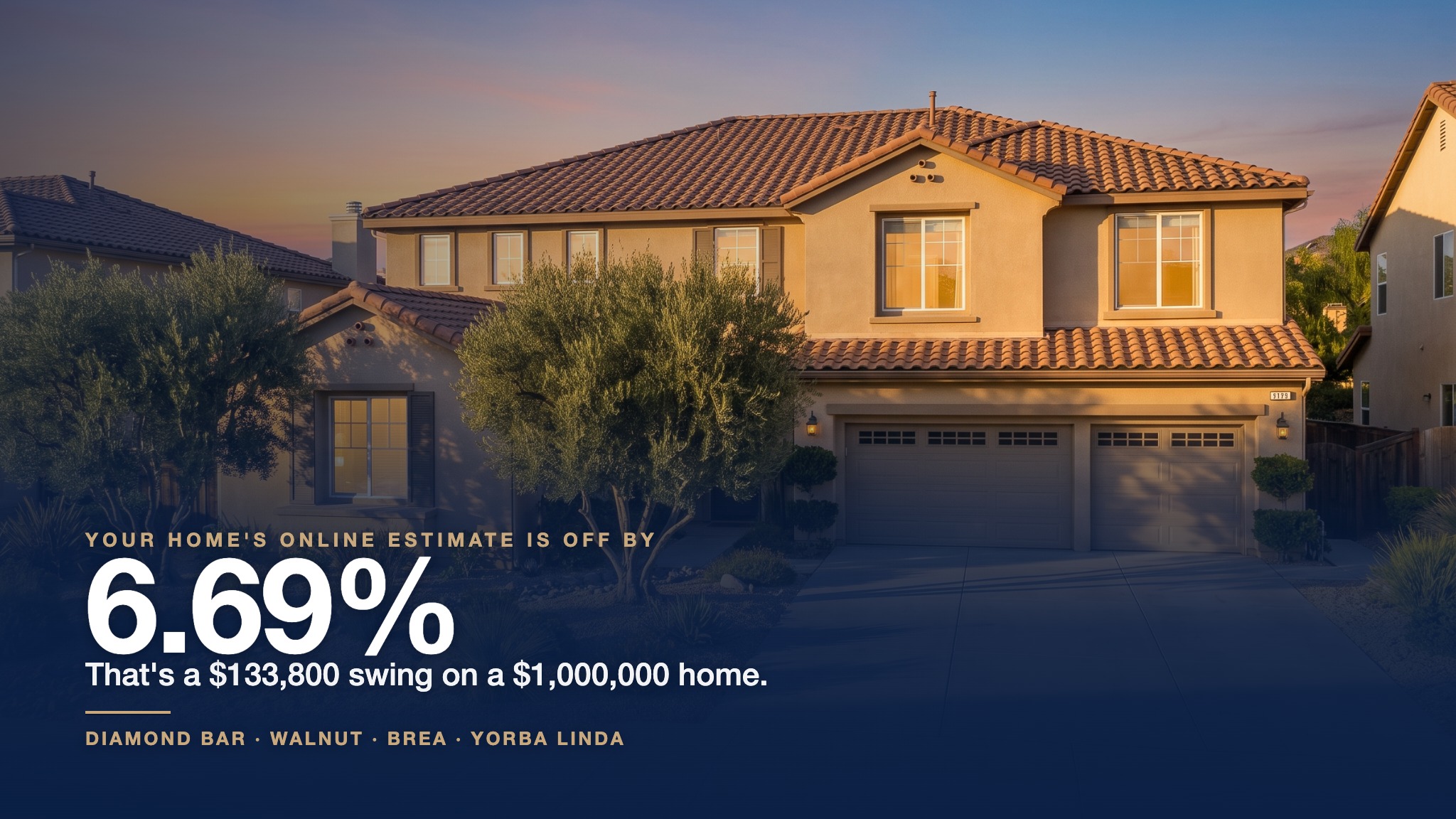
- Zillow’s published off-market error rate for our metro is 6.69% — roughly a $133,800 swing on a $1,000,000 home. Chino and Chino Hills run 5.87%.
- Fewer than 4 in 10 off-market estimates land within 5% of the actual sale price, and more than 1 in 8 miss by over 20%.
- The widely quoted 1.90% accuracy figure only applies after a home is listed — once the algorithm can see the list price.
- So the number most homeowners rely on before deciding to sell is the least accurate one.
- Brea and Walnut closed July within $2 per square foot of each other — but Walnut takes nearly 3× as long to sell. No algorithm sees that.
- Since October 1, 2025, federal rules require lenders using automated valuations to meet quality-control standards — but those rules do not cover the consumer estimate on your screen.
- An estimate is a starting point for a conversation. It is not a list price, and it is never a substitute for an appraisal.
Data as of August 17, 2026. Jack Ma | REALTOR® | DRE #01869426 | Century 21 Masters.
Almost every homeowner I meet has already looked their home up online before they call me. That is completely reasonable — it is free, it takes four seconds, and it gives you a number.
The problem is not that the number exists. The problem is that it is far less certain than it looks, and it is least certain at exactly the moment you are using it.
Here is what the published data actually says, what it means in dollars on a Diamond Bar, Walnut, Brea or Yorba Linda home, and the one thing no algorithm can see — which I can show you directly in last month’s numbers.
How accurate is the Zestimate in Diamond Bar, Walnut, Brea, and Yorba Linda?
To Zillow’s credit, they publish their own accuracy figures rather than burying them, and they update them monthly. Zillow reports our area as a single metro — Los Angeles-Long Beach-Anaheim — which covers Los Angeles County and Orange County together, so one set of numbers applies to Diamond Bar, Walnut, Brea and Yorba Linda alike.
There are two numbers, and the gap between them is the entire story.
| Home Status | Median Error Rate | Dollar Error on $1M | Likely Range |
|---|---|---|---|
| Actively listed | 1.90% | ± $19,000 | $981,000 – $1,019,000 |
| Off-market (not listed) | 6.69% | ± $66,900 | $933,100 – $1,066,900 |
That second row is the one that applies to you. If you have not listed your home, you are an off-market home. On a $1,000,000 property the spread is roughly $133,800 — real money in any market, and easily enough to change whether a move pencils out at all.
Zillow figures for the Los Angeles-Long Beach-Anaheim metro, last refreshed August 14, 2026. Nationally the rates are 1.78% on-market and 7.20% off-market. A median error rate means half of homes land inside that band and half land outside it — it is not a guarantee that your home falls in the range.
The median hides how wide the misses get
A median is the middle. It tells you nothing about the tail — and the tail is where people get hurt. Zillow publishes that distribution too, and it is far more revealing than the headline number.
| Share of homes where the estimate landed… | Actively listed | Off-market |
|---|---|---|
| Within 5% of the sale price | 81.99% | 39.51% |
| Within 10% | 94.67% | 65.34% |
| Within 20% | 98.79% | 86.50% |
Read the off-market column slowly. Fewer than four homes in ten land within 5% of what they actually sell for. Barely two-thirds land within 10%.
And the last row is the one that should stop you: 13.5% of off-market homes — better than one in eight — miss by more than 20%. On a typical Diamond Bar home that is a miss of more than $220,000. In Yorba Linda, more than $320,000.
Once the same homes are actively listed, 82% land within 5%. That is the difference the next section explains.
Why does the estimate look so accurate once a home is listed?
This is the part almost nobody explains, and it is the single most important thing to understand about that number.
Once your home hits the market, the algorithm gets to see your list price. Zillow states this directly. Asked why a Zestimate changes when a home is listed, Zillow explains that for on-market homes the estimate incorporates listing information such as the list price and recent market activity, which provide additional signals about the home’s likely sale price.
Their published methodology goes further: accuracy for active homes is measured by comparing the last on-market Zestimate — the one calculated after the home was listed and priced — against the final sale price.
So the impressive 1.90% figure is measured after the model has been handed a very strong hint about the answer. A real estate professional studied the property, priced it, and published that price. The algorithm then grades itself against a number it was partly given.
To be fair to Zillow, they are clear that the Zestimate does not simply mirror the list price — it still weighs comparable sales and market conditions. But the list price is a signal, and the jump from 39.51% to 81.99% of homes landing within 5% the moment a home is listed tells you how much that signal is worth.
Before you list, there is no hint. There is only recorded data. And that is precisely when you are sitting at your kitchen table deciding whether it makes sense to sell.
✓ The short version
The estimate is most accurate when you need it least — after the pricing work is already done. It is least accurate when you need it most — before you have decided anything.
What does a 6.69% error actually cost in your city?
A percentage is abstract. Dollars are not. Applying the published off-market error rate to the current median list price in each city shows the range you are really working with.
| City | Median Active List Price | ± 6.69% | Total Spread |
|---|---|---|---|
| Yorba Linda | $1.6M | ± $107,040 | $214,080 |
| Walnut | $1.5M | ± $100,350 | $200,700 |
| Brea | $1.2M | ± $80,280 | $160,560 |
| Diamond Bar | $1.1M | ± $73,590 | $147,180 |
Illustration only. The 6.69% figure is a county-level median applied to each city’s current median active list price — it is not a measured city-level error rate. Your individual home may be considerably closer or further off.
Why do two cities with the same price per square foot behave completely differently?
This is the part I have never seen anyone write about, and it is the clearest evidence that an algorithm cannot price your home.
Look at July 2026 closed sales across the four cities.
| City | Median Sale Price | Median $/Sq. Ft. | Sale-to-List | Expected Market Time |
|---|---|---|---|---|
| Yorba Linda | $1,307,500 | $601 | 100.0% | 69 days |
| Brea | $1,265,000 | $586 | 100.0% | 52 days |
| Walnut | $1,184,400 | $584 | 98.7% | 148 days |
| Diamond Bar | $958,600 | $563 | 98.7% | 146 days |
Now compare Brea and Walnut, two cities about twenty minutes apart.
✓ Brea — $586/sq. ft.
Expected market time 52 days. Closed at 100.0% of list price with a median 11 days on market in July.
⚠️ Walnut — $584/sq. ft.
Expected market time 148 days. Closed at 98.7% of list price. Nearly three times Brea’s absorption pace.
Two dollars per square foot apart in value. Nearly three times apart in how long it takes to sell.
An automated model looks at those two markets and sees the same thing, because price per square foot is the input it understands. But price per square foot tells you what homes are worth. It tells you nothing about how many buyers are competing for them.
That distinction is not academic. It determines whether your asking price is realistic, how much room you have to push, whether you should expect multiple offers or a long quiet stretch, and what your negotiating position looks like in week six. Diamond Bar sits in the same position as Walnut at 146 days, while Yorba Linda at 69 days behaves much more like Brea.
Absorption is invisible to an algorithm and obvious to anyone actually working the market. It is one of the main reasons two homeowners with similar estimates can have completely different outcomes.
What can an algorithm not see about your home?
Automated valuation models are genuinely good at what they do. They process enormous amounts of recorded data in seconds, and on a uniform tract home with several recent, nearly identical sales on the same street, they perform well. I will say that plainly, because it is true — a Brookings Institution review found that seven AVM providers predicted within 10% of the sale price for at least 95% of properties.
But the same review cites something more revealing. One commercial AVM provider estimates that only about 40% of homes can be appropriately evaluated by an automated model alone. Roughly six in ten need a human being.
What they cannot do is walk through your front door.
Condition and improvements
Kitchen and bath remodels. Flooring. Roof and HVAC age. Deferred maintenance. Whether an addition was permitted — a recurring and expensive question in our area. If you have an ADU or unpermitted addition, automated models handle it badly or ignore it entirely.
Lot and location nuance
This matters enormously here. Two Diamond Bar homes with identical square footage can be worth very different amounts depending on whether the lot is flat and usable or steeply sloped, whether there is a city-lights view, whether the backyard is private or overlooked, and whether the home fronts a busy connector or sits on a quiet cul-de-sac. The same is true across Yorba Linda’s hillside tracts. Tax records show lot size. They do not show what the lot is like.
Floor plan and livability
A downstairs bedroom and full bath carries a meaningful premium in our multigenerational market. So does a true primary suite, an open kitchen-to-family-room flow, and natural light. Square footage counts the space; it does not describe how the space works.
Which comparable sales the model chose
This is the quiet one. If the algorithm anchored on a trust sale that closed in original 1978 condition, or a home sold off-market between family members, your estimate inherits that distortion — and you have no way of knowing it happened.
How fast your market is actually moving
As the Brea and Walnut comparison shows, absorption pace is not an input. It is arguably the most important thing you need to know before setting a price.
Do federal regulators consider these estimates reliable?
This is the part almost nobody knows about, and it settles the argument better than any opinion I could offer.
On October 1, 2025, a federal rule took effect governing automated valuation models. Six agencies wrote it together — the Consumer Financial Protection Bureau, the Office of the Comptroller of the Currency, the Federal Reserve, the FDIC, the National Credit Union Administration, and the Federal Housing Finance Agency.
Any lender using an automated valuation to make a mortgage credit decision now has to maintain quality-control standards designed to:
- Ensure a high level of confidence in the estimate
- Protect against the manipulation of data
- Avoid conflicts of interest
- Require random sample testing and review
- Comply with applicable nondiscrimination laws
Read that list again. Regulators looked at this exact technology and concluded it needed guardrails before it could be trusted in a lending decision.
Now the important part: that rule does not apply to the estimate on your screen. Its scope covers AVMs used by mortgage originators and secondary market participants in credit and securitization decisions. Consumer-facing home value estimates sit outside it entirely.
⚠️ What this actually means
A bank cannot rely on an automated valuation to approve your mortgage without meeting federal quality-control standards. But anyone — including you — can look up a free consumer estimate that is held to no such standard, and treat it as the value of the largest asset they own.
What about asking ChatGPT what your home is worth?
More homeowners are doing this every month, so it deserves a straight answer rather than a defensive one.
It can work. In March 2026, Fortune reported on a Florida homeowner who used ChatGPT to guide pricing, marketing and negotiation on his own sale. The home closed in five days at $954,800 — roughly $100,000 above what agents had estimated. That is a real outcome and I am not going to pretend otherwise.
Read the details, though. He still hired an attorney. He said the tool required constant human engagement and could not handle showings or the physical work of a move. And much of what he gained came from strategy and marketing, not from the valuation itself.
Now the other side. Luxury agent Ryan Serhant described on CNBC how ChatGPT nearly collapsed a $50 million transaction — by telling the seller the home was worth more, while simultaneously telling the buyer they were overpaying.
That story is the whole problem in one sentence. A general-purpose chatbot has less property data than Zillow does, and it is agreeable by design. Ask it whether your home might be worth more and it will find reasons to say yes. Ask as the buyer whether you are overpaying and it will find reasons to say yes to that too. It is not lying — it simply has no independent view of your street, and it is optimized to be helpful to whoever is asking.
An algorithm that is confidently wrong is a problem. An algorithm that confidently agrees with you is a more expensive one.
What about Chino and Chino Hills?
Chino and Chino Hills sit in San Bernardino County, which Zillow reports under a different metro — Riverside-San Bernardino — so they get their own numbers.
The off-market median error there is 5.87%, with 1.57% for actively listed homes. Slightly tighter than the Los Angeles-Long Beach-Anaheim metro, but the same pattern and the same warning: on a $1,000,000 Chino Hills home, 5.87% is still a swing of about $117,400.
The reason it runs a little tighter is instructive. Much of the Riverside-San Bernardino metro is newer, more uniform tract housing with dense recent sales — exactly the conditions where an algorithm performs best. But Chino Hills in particular has plenty of hillside lots, view premiums and larger custom parcels that look nothing like that average. If your home is one of those, the metro-wide figure is optimistic for you.
If you own in Chino Hills or Chino, I am happy to pull current figures for your specific tract. The same goes for anyone in Diamond Bar, Walnut, Brea or Yorba Linda.
🏘️ What Is Your Home Worth Right Now?
Free home valuation based on current sold comparables — not active list prices.
So how should you actually use an online home estimate?
I am not going to tell you to ignore it. That would be unrealistic and a little self-serving. Use it — just use it correctly.
Treat it as a range, not a number. When you see $1,100,000 on a Diamond Bar home, mentally read it as “somewhere between roughly $1,026,000 and $1,174,000, and possibly outside that.” That is a more honest reading of the same data.
Use it to track direction, not level. Watching your estimate drift over six months tells you something real about market movement. The absolute figure on any given day tells you much less.
Be aware of what the first number does to you. This is the part I see most often and the part homeowners rarely notice in themselves. Whatever figure you see first becomes the anchor everything else gets measured against — including a well-researched price that happens to be lower. One industry trainer put it memorably this year: every seller now arrives with “a Ph.D. in Real Estate from the University of Zillow.” That is not a knock on sellers. It is how anchoring works on everyone, and knowing it is happening is most of the defense.
Never use it as a list price. In July 2026, closed sales came in at a 100.0% sales-to-list ratio in Los Angeles County and 99.5% in Orange County — correctly priced homes are getting their asking price. But that statistic only works in your favor if the asking price was right to begin with. Price off a loose off-market estimate and you either leave money on the table or you sit, go stale, and negotiate from weakness. In a market where Walnut and Diamond Bar are running near 150 days, that is a costly mistake, and it is the most common reason a home does not sell.
Never use it for probate, trust, or divorce purposes. Zillow says directly that it is not an appraisal and cannot substitute for one. Those situations require a valuation tied to a specific date with documented comparables.
Then get a real opinion of value before you decide anything. Not because an agent is magic, but because pricing a home correctly means standing in it, knowing which recent sales are genuinely comparable, and understanding how fast your specific market is moving right now.
Free — No Obligation
Find Out What Your Home Is Actually Worth
I will walk your home, pull the genuinely comparable closed and pending sales in your tract, show you how fast your market is actually moving, and give you a realistic range plus a net proceeds breakdown. No pressure, no listing pitch — just the real number.
📅 Book a Free 15-Min Call
📞 909.610.5188
Jack Ma | REALTOR® | DRE #01869426 | Century 21 Masters | Diamond Bar · Walnut · Brea · Yorba Linda · Chino Hills · Chino
You can also request a detailed net proceeds analysis to see what you would actually walk away with after costs — which, for most homeowners weighing a move, matters far more than the estimate on a website.
Frequently Asked Questions
How accurate is the Zestimate in Diamond Bar, Walnut, Brea, and Yorba Linda?
Zillow reports this area as the Los Angeles-Long Beach-Anaheim metro, covering both counties. As of August 2026: 1.90% median error for actively listed homes, 6.69% for off-market homes — about a $133,800 swing on a $1,000,000 home. The distribution matters more than the median: only 39.51% of off-market estimates land within 5% of the sale price, and 13.5% miss by more than 20%. Chino and Chino Hills sit in the Riverside-San Bernardino metro at 5.87%.
Why does the Zestimate get more accurate after a home is listed?
Because the algorithm gets to see the list price. Zillow states that on-market information including listing price, the listing description, comparable homes and days on market feed the calculation. The flattering 1.90% figure is measured after the model has been handed a strong hint. Before you list there is no hint — and that is exactly when most homeowners are checking.
Why do Brea and Walnut have the same price per square foot but sell at different speeds?
In July 2026 the median closed price per square foot was $586 in Brea and $584 in Walnut — a $2 difference. But expected market time was 52 days in Brea versus 148 days in Walnut, nearly three times longer. Price per square foot tells you what homes are worth; it says nothing about how quickly buyers are absorbing inventory. An algorithm sees two identical markets. They behave nothing alike.
Do federal regulators consider automated home valuations reliable?
Partly — and the detail matters. Since October 1, 2025, any lender using an automated valuation in a mortgage credit decision must maintain quality-control standards: high confidence in the estimate, protection against data manipulation, no conflicts of interest, random sample testing, and nondiscrimination compliance. Six agencies issued it jointly (CFPB, OCC, Federal Reserve, FDIC, NCUA, FHFA). But the rule covers lenders — not the consumer estimate on your screen, which is held to no equivalent standard.
Can ChatGPT tell me what my house is worth?
It will give you a number — treat it with more caution than a Zestimate, not less. A general chatbot has less property data than Zillow and is built to be agreeable to whoever is asking. Ryan Serhant described on CNBC how ChatGPT nearly collapsed a $50 million deal by telling the seller the home was worth more and telling the buyer they were overpaying. There are wins too — Fortune reported in March 2026 on a Florida owner who sold in five days for roughly $100,000 above agent estimates using ChatGPT for pricing and marketing, though he also hired an attorney and said it needed constant human input.
Why is my Zestimate different from what my agent says my home is worth?
An automated model works from recorded data — square footage, bed and bath count, lot size, tax records, nearby sales. It has never been inside your home. It does not know your kitchen was remodeled last year, that your lot is flat and usable rather than steeply sloped, that your addition was never permitted, or that the “comparable” two streets over was a trust sale in original condition.
Can I use a Zestimate for probate, a trust, or a divorce?
No. Zillow states plainly that a Zestimate is not an appraisal and cannot be used in place of one. Probate, trust administration and divorce all require a valuation tied to a specific date and supported by comparable sales documentation. A screenshot will not satisfy a court, an attorney, or the IRS. For date-of-death valuations you need a formal appraisal or a documented broker price opinion.
Should I list my home at the Zestimate price?
No — treat it as a starting point for a conversation, not a list price. In July 2026 the sales-to-list price ratio was 100.0% in Los Angeles County and 99.5% in Orange County, meaning correctly priced homes sold at or very near asking. That only helps if the asking price was right to begin with. With Walnut and Diamond Bar running near 150 days of market time, an overpriced start is expensive.
How do I get an accurate home value in Diamond Bar, Walnut, Brea, or Yorba Linda?
Start with recent closed and pending sales in your specific tract, then adjust for condition, upgrades, lot usability, view, floor plan and permit status — and factor in how quickly your city is actually absorbing inventory. That takes someone who has been inside comparable homes. I provide a free net proceeds analysis for homeowners in Diamond Bar, Walnut, Brea, Yorba Linda, Chino Hills and Chino — call 909.610.5188 or book a 15-minute call.
About Jack Ma — REALTOR® | DRE #01869426
Jack Ma is a licensed Broker Associate with Century 21 Masters (DRE #01869426) with 15+ years serving the tri-county border area of Los Angeles, Orange, and San Bernardino County. 300+ homes sold. 101.9% list-to-sold ratio in 2026. Specializing in Diamond Bar, Walnut, Chino Hills, Brea, Yorba Linda, Rowland Heights, and La Habra. Bilingual English and Mandarin. 909.610.5188 | [email protected]
Related Reading
Disclaimer: Zestimate accuracy figures are as published by Zillow for the Los Angeles-Long Beach-Anaheim and Riverside-San Bernardino metro areas, last refreshed August 14, 2026, and are updated monthly — check Zillow for current figures. Local market statistics are drawn from the latest local market data as of August 17, 2026, tabulated from CRMLS, and may not reflect all real estate activity in the market. Median figures describe groups of homes, not individual properties — your home may perform differently. This article is general information, not an appraisal, tax advice, or legal advice. For probate, trust, or estate matters, consult a qualified attorney and a licensed appraiser. Jack Ma | REALTOR® | DRE #01869426 | Century 21 Masters.