

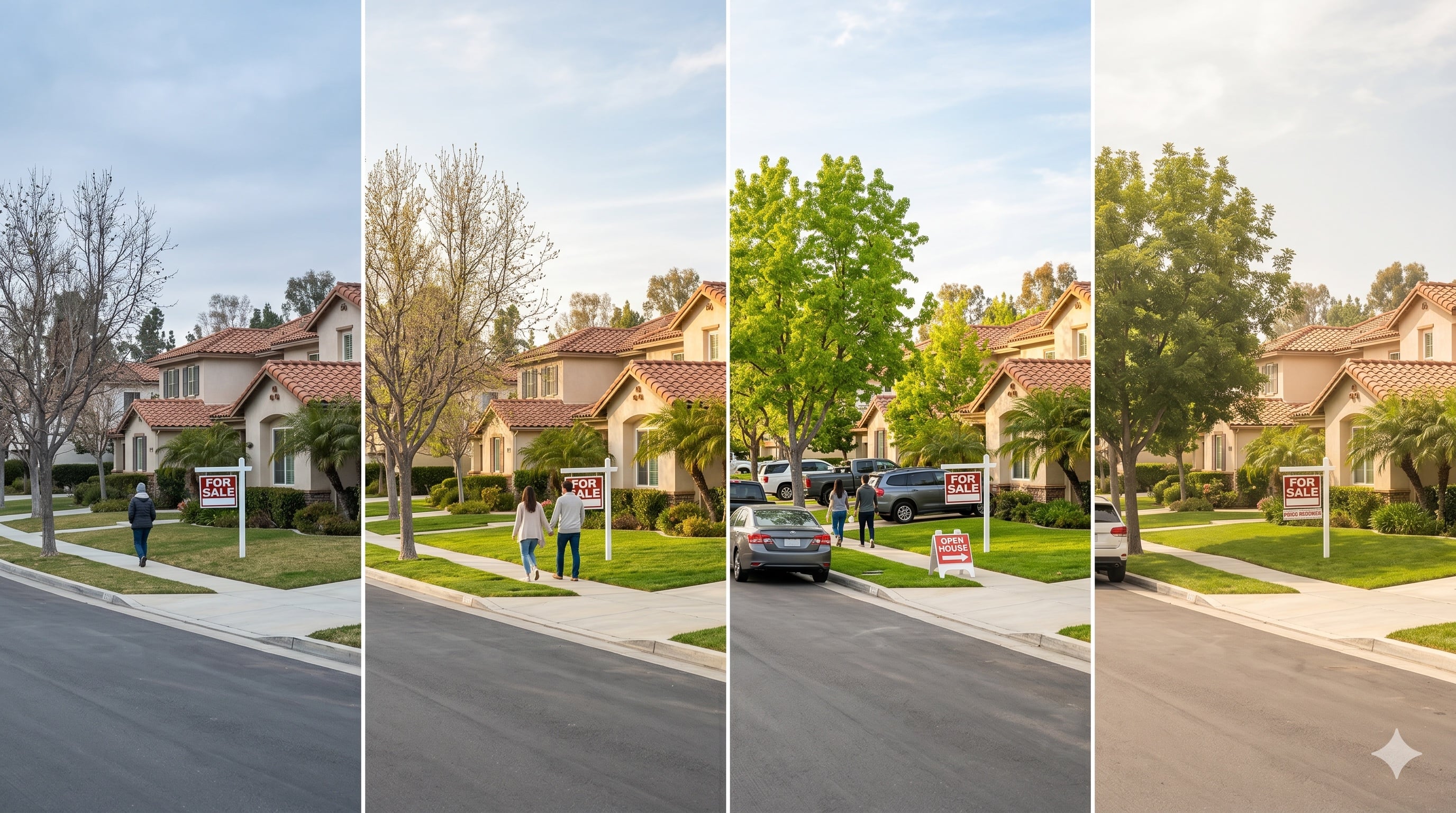
Most real estate advice sounds the same everywhere: list in spring, avoid winter, watch mortgage rates. But if you have lived in the San Gabriel Valley, North Orange County, or the tri-county border area of Los Angeles, Orange, and San Bernardino County, you know the market does not follow a simple calendar.
It follows a rhythm. And once you understand that rhythm, you can time your decisions — whether you are buying or selling — with precision that most people never achieve.
This guide is based on 15+ years of direct market observation combined with three years of local InfoSparks MLS data covering the San Gabriel Valley and North Orange County — including Diamond Bar, Walnut, Chino Hills, Brea, Yorba Linda, Rowland Heights, and La Habra. What follows is what the data actually shows — season by season.
2026 Seasonal Market Summary — San Gabriel Valley & North Orange County Buyers & Sellers
- Peak buyer demand: April — pending sales reach 436–500/month locally. Fastest market of the year.
- Strongest seller window: March through mid-June — multiple offers, shortest days on market (28–31 days), highest sale-to-list ratios
- Best buyer opportunity: Mid-November through December — motivated sellers, less competition, average DOM spikes to 42–47 days
- Demand peaks out: Mid-June — buyer activity begins slow decline through Labor Day as inventory keeps rising
- The Veterans Day inflection point: After November 11, closed sales and new listings drop dramatically — but both buyers and sellers still active are at their highest motivation level of the entire year
- The January surprise: Buyer demand returns faster than inventory January through mid-March — a brief window of low competition for buyers who act early
Data source: InfoSparks CRMLS MLS, 3-year monthly trend data. Jack Ma | REALTOR® | DRE #01869426 | Century 21 Masters.
⚠️ Important: What This Seasonal Guide Does — and Does Not — Tell You
The seasonal patterns in this guide reflect normal cyclical conditions based on three years of local MLS data. They describe what happens when the market follows its natural rhythm.
They do not account for outside forces that can override seasonality entirely. A sudden drop in mortgage rates can bring buyers flooding into the market in December. A geopolitical event — like the Iran conflict that began in late February 2026 — can cause both supply and demand to pull back simultaneously in what would otherwise be a strong spring window. A recession, a major employer leaving the area, or a dramatic policy change can shift the entire dynamic.
The most important thing to understand: Real estate decisions should be based on your life situation — not the calendar, and not what the market is doing. If you need to sell because of a job change, a growing family, a divorce, a death in the family, or a financial decision — those are the right reasons to sell. The seasonal data helps you execute that decision as strategically as possible. It should not be the reason you make it.
Use this guide to optimize your timing. Don’t use it to delay a decision that your life is already telling you to make.
The SGV & North Orange County Seasonal Real Estate Matrix
Use this quick-reference matrix to understand what to expect in each season — and how to position yourself strategically as either a buyer or seller.
| Season | Pending Sales | Avg DOM | Inventory Trend | Seller Playbook | Buyer Playbook |
|---|---|---|---|---|---|
| 🏁 Spring March – May |
Peak 436–500 | 28–31 days | Rising fast | 🏆 Launch now — maximum competition | ⚠️ Get pre-approved early. Move fast. |
| ☀️ Summer June – August |
Declining 380–430 | 35–42 days | At peak then falling | ⚠️ Price precisely — demand is cooling | ✓ Look for 45+ day listings — leverage returns |
| 🍂 Fall Sept – Oct |
Recovering 350–400 | 35–40 days | Declining | ✓ Last real window — refresh marketing | ✓ Motivated sellers still active |
| ❄️ Winter Nov 11 – Feb |
Lowest 300–320 | 42–47 days | At lows | 🏆 Highest seller motivation of the year — serious, non-contingent buyers only | 🏆 Highest buyer leverage of the year — motivated sellers, no competition |
Source: InfoSparks CRMLS 3-year monthly MLS data, tri-county border area. Jack Ma | DRE #01869426 | Century 21 Masters. Based on normal market conditions — outside factors such as rate changes or geopolitical events can override seasonal patterns.
What Happens to the San Gabriel Valley Real Estate Market After Veterans Day?
What happens after November 11 and why it matters more than you think
There is a moment in the San Gabriel Valley real estate calendar that happens every single year without exception. After Veterans Day — November 11 — closed sales volume begins a steep, predictable decline that continues through the end of December.
The local MLS data tells the story clearly. Pending sales drop from the 380–430 range in October to 300–320 by late December — a decline of roughly 25–30% in just six weeks. New listings follow the same pattern. Buyers and sellers pull back simultaneously as attention shifts to holidays, family gatherings, travel, and the general cultural pressure to pause major decisions until the new year.
What this means for sellers: If you are not already in contract by Veterans Day, you face a meaningful choice. You can push through the holiday period — and face dramatically reduced buyer traffic — or you can withdraw your listing and re-launch in January or February when demand returns. A home that sits through November and December accumulates days on market history — and if you need to sell quickly regardless of season, our fast home sale guide covers your options that buyers and their agents will use as a negotiating weapon in spring.
What this means for buyers: This is one of the most underutilized windows in the entire annual calendar. The sellers who stay active through the holidays are typically the most motivated — they have a reason to move, whether it is a job relocation, an estate sale, a divorce, or a financial situation that does not improve by waiting. Days on market average 42–47 days during this period compared to 28–31 days in spring. Sellers are more negotiable. Competition is minimal. If you are willing to look at homes while others are watching football and eating turkey, you may find the best deal of the year.
💡 The Most Overlooked Winter Insight
Low Transactions Does NOT Mean Low Motivation — It Means the Opposite
Here is what most buyers and sellers get wrong about the winter market: they see low transaction volume and assume low interest. The reality is the exact opposite.
The sellers active in November and December are not casually testing the market. They have a real reason to move — a job relocation, a family change, a financial decision, an estate sale. They listed during the hardest time of year to sell. That is motivation by definition.
The buyers active in November and December are not casual browsers. Nobody tours homes in December for fun. They have a timeline, a reason, and the clarity that comes from having already watched the spring and summer markets pass without finding the right home.
Both sides of the winter transaction are at their highest motivation of the year. The low transaction volume is not a sign of low interest — it is the natural result of fewer people being forced by life circumstances to move in winter. The ones who are there are serious.
Why Does Buyer Demand Return Faster Than Listings in January and February?
Why buyer demand returns faster than inventory every single year
Something consistent happens every January in the San Gabriel Valley that most buyers and sellers miss entirely.
The moment the calendar turns, buyers who have been waiting out the holidays begin their searches again. Phone calls pick up. Showing requests increase. Online property searches spike. But the inventory — the actual number of homes available to buy — takes several more weeks to catch up. Sellers are still preparing their homes, finishing renovations, waiting for the right moment to list.
The result is a brief but meaningful window: buyer demand increases faster than listings from January through mid-March. Buyers who act in this window face less competition than they will in April, May, or June — but they are shopping in a market that is already warming up. Homes that are priced correctly and show well are going under contract quickly even in January and February.
This is the window that sophisticated buyers — the ones who have been watching the market since October — use to their advantage. They know the spring rush is coming. They act before it arrives.
For sellers: A well-prepared, correctly priced listing that hits the market in late January or February often performs surprisingly well. The competition from other sellers is still low. The buyers who are active in January are serious — they are not casual browsers. They are ready to move.
Why Is April the Most Competitive Month to Buy or Sell a Home in the San Gabriel Valley?
The single most competitive month to buy a home in the San Gabriel Valley
April is the peak. Three consecutive years of local MLS data confirm it without ambiguity. Pending sales in the San Gabriel Valley and surrounding tri-county area hit their annual high point in April — 436 to 500 pending transactions per month. Average days on market drop to 28–31 days. Sale-to-list price ratios climb to 100% and above in the most in-demand cities.
This is not a coincidence. April represents the convergence of several forces simultaneously:
- Families who want to move before the school year ends are making decisions now
- Tax returns have arrived, providing down payment funds for first-time buyers
- Spring weather makes homes show at their best
- The psychological momentum of the new year has fully arrived
- Buyers who started looking in January and February are now ready to commit
For sellers, April is the ideal time to be on market — not just listed, but actively showing. A home that launched in late February or early March and has been building momentum will often receive its best offer in April. A home that lists for the first time in April is entering the most competitive buyer environment of the year.
For buyers, April is the month that tests your preparation. If you are not pre-approved, have not toured enough homes to recognize value quickly, and are not working with an agent who can move fast — you will lose homes to buyers who are. The best-priced, best-located homes in Diamond Bar, Walnut, Chino Hills, Brea, and Yorba Linda do not last more than a week in April. Many sell with multiple offers in the first weekend.
Want to understand which months are hardest for sellers in Southern California and exactly how the data compares month by month? That full analysis is available on our site.
📈 April by the Numbers
436–500 pending sales. 28–31 days on market. 100%+ sale-to-list ratio.
This is the fastest, most competitive month of the year in your market. Sellers win. Buyers need preparation.

Saturday June 13, 2026 | 10:00 AM Pacific | Free | Jack Ma + Yvonne Wu (RT Property Management)
What Makes the Mid-April Through Mid-June Window the Heart of the SGV Market?
Strong demand, rising inventory, and the window where strategy matters most
The window from mid-April through mid-June is the heart of the San Gabriel Valley real estate season. Buyer demand remains near its April peak while new listings continue flooding the market. Active inventory climbs from the 800–900 range in winter toward the 1,200–1,400 range by late May.
This is the period where preparation and pricing strategy separate successful sellers from frustrated ones. A home that is staged, photographed professionally, priced correctly based on actual sold comparables, and launched with full marketing exposure will attract multiple offers and sell quickly. A home that is overpriced — even by 5–10% — will sit while the correctly priced competition sells around it.
The spring market is not a rising tide that lifts all boats. It is a competitive environment that rewards preparation and punishes overpricing. Understanding why some homes sit while others sell is the most important thing a seller can know before listing in this window.
For buyers in this period, the strategy is different. There are more choices than in January–February, but also more competition. The most important skill is recognizing value quickly — knowing which homes are correctly priced versus which are inflated, and having the clarity to act decisively when you find the right one.
What Happens When Buyer Demand Peaks Out in Mid-June?
When the market shifts and inventory starts working against sellers
Around mid-June, something shifts. Buyer demand begins its gradual decline. Families who needed to move before the school year have made their decisions. The urgency that drove April and May activity starts to dissipate. But active listings — the homes available to buy — continue rising through July and August.
The result: more homes, fewer buyers. Average days on market begin climbing from the spring lows of 28–31 days toward 35–42 days. The sale-to-list ratio softens slightly. Price reductions start appearing more frequently in the active listing data.
This does not mean the summer market is dead. It is not. But it is a fundamentally different environment than spring. Sellers who priced correctly and listed at the right time have already sold. The homes still active in late July and August are competing for a smaller, more deliberate buyer pool.
For sellers who must list in summer: correct pricing is not optional. The summer buyer is more patient, more analytical, and has more choices than the spring buyer. They will not overpay. They will wait you out if you are overpriced. The data on the hardest months to sell in Southern California shows that summer listings that linger often carry those days on market all the way into the fall — compounding the problem.
For buyers: summer is actually a good window to negotiate. Motivated sellers who have been on the market 45–60+ days are psychologically different from sellers who just listed. They have experienced the disappointment of watching the spring rush pass them by. That creates leverage for prepared buyers.
Does the San Gabriel Valley Real Estate Market Recover in September and October?
A brief but real recovery before the holiday slowdown
September and October bring a mini-recovery that many buyers and sellers do not anticipate. After the summer slowdown, there is a genuine uptick in activity as families who could not find the right home in spring return to the search. The weather is still comfortable. School has just started, creating clarity for families about their district needs. And the looming holiday season creates a sense of urgency — if they do not act now, they will be waiting until January.
Active inventory begins declining from its summer peak as some sellers pull their listings before the holidays. This reduction in competition — combined with renewed buyer demand — creates a brief but productive market window in October especially.
For sellers with a home that did not sell in spring or summer: October is often the last real opportunity before the Veterans Day cliff. A price adjustment in late September, combined with fresh marketing and photography, can generate renewed interest before the market goes quiet.
For buyers: the fall window offers a combination of motivated sellers (some of whom have been trying to sell since spring) and slightly declining inventory as sellers withdraw for the holidays. It is not spring, but it can be a productive time to make a move.
What Does the Full Year Seasonal Calendar Look Like for SGV & North Orange County?
| Period | Pending Sales | Avg DOM | For Sellers | For Buyers |
|---|---|---|---|---|
| Nov 11 – Dec 31 | 300–320 (lowest) | 42–47 days | ⚠️ Tough — consider withdrawing | ✓ Best leverage of the year |
| Jan – mid March | 320 → 420 (rising) | 33–40 days | ✓ Good — early mover advantage | ✓ Beat the spring rush |
| April | 436–500 (peak) | 28–31 days | 🏆 Peak — maximum competition | ⚠️ Hardest month to buy |
| Mid April – Mid June | 420–480 (strong) | 28–35 days | ✓ Strong — pricing critical | ✓ Good selection + competition |
| Mid June – Labor Day | 380–430 (declining) | 35–42 days | ⚠️ Harder — price correctly | ✓ Negotiating leverage returns |
| September – Oct 31 | 350–400 (recovering) | 35–40 days | ✓ Last real window before holidays | ✓ Motivated sellers still active |
Source: InfoSparks CRMLS 3-year monthly MLS data. Jack Ma | DRE #01869426 | Century 21 Masters.
How Should San Gabriel Valley Sellers Use the Seasonal Calendar?
The most important decision a seller makes is not the list price — it is the launch timing. A correctly priced home that launches in late February or early March builds momentum going into the April peak. A correctly priced home that launches in mid-July is fighting a market that is moving away from it.
If your timing is flexible, aim to be on market and showing by the first week of March. That gives you February to prepare — cleaning, repairs, staging, photography — and puts you in the market as buyer demand accelerates into its spring peak.
If your timing is not flexible and you need to sell in a slower season — and you are also thinking through the tax implications — our California capital gains tax guide is worth reading before you set your timeline, the strategy is different. Correct pricing from day one becomes non-negotiable. You cannot afford to start high and reduce — every price reduction is a signal that damages your negotiating position. Understanding your actual net proceeds before you price is the foundation of a successful off-season sale.
One final note before we go further: these are baseline seasonal patterns under normal conditions. Outside forces — a sudden rate drop, a geopolitical event, an economic shock — can override seasonality quickly and completely. The patterns described here tell you what to expect when conditions are stable. When conditions shift, the analysis shifts with them. That is why working with a local specialist who monitors the market in real time matters more than any seasonal calendar.
If your home is currently on the market and not selling, the season matters. A home sitting in August with 75 days on market is in a different position than a home sitting in February with 75 days on market. Our free Listing Rescue Audit can help you diagnose exactly what is holding your listing back.
How Should San Gabriel Valley Buyers Use the Seasonal Calendar?
The single most powerful thing a buyer can do is get ready before the market gets busy. That means financing in order, priorities clear, and an agent who can move fast — all of it done by January. Then you have a choice the spring buyer does not have: you can shop in the January–February window when competition is low and motivated sellers are still active.
If you missed the early window and are shopping in spring, the strategy shifts to preparation and speed. The homes that sell in April and May sell fast. Being pre-approved is not optional. Knowing your must-haves versus nice-to-haves in advance lets you make a decision in hours, not days. And working with an agent who brings you market data — not just listing alerts — is the difference between competing effectively and losing homes repeatedly.
For a deeper analysis of the current market and whether now is the right time to buy given inflation and current conditions, see our full 2026 market analysis.
Free — No Obligation — Tri-County Area Specific
Talk Timing Before You Make Your Move
Whether you are thinking about buying, selling, or simply trying to understand where we are in the seasonal cycle right now — a 15-minute conversation with a local specialist who watches this market every day is the most useful thing you can do.
📅 Book a Free 15-Min Call
📞 909.610.5188
Jack Ma | REALTOR® | DRE #01869426 | Century 21 Masters | Serving Diamond Bar, Walnut, Chino Hills, Brea, Yorba Linda, Rowland Heights, La Habra & North Orange County
🏠 What Is Your San Gabriel Valley Home Worth Right Now?
Curious what your Diamond Bar, Walnut, Chino Hills, Brea, Yorba Linda, Rowland Heights, or La Habra home is worth in today’s San Gabriel Valley or North Orange County market? Get a free, no-obligation home valuation based on current sold comparables — not active list prices that may never close.
Free home valuation — no obligation — takes less than 60 seconds
Related Reading
- What Is the Hardest Month to Sell a House in Southern California?
- Why Is My Home Not Selling in the San Gabriel Valley?
- Is the Housing Market Crashing? What Inflation Is Doing to SGV Home Prices
- Free Net Proceeds Analysis — What Will You Actually Walk Away With?
- Free Listing Rescue Audit — Why Isn’t Your Home Selling?
- Diamond Bar vs Chino Hills vs Walnut — 2026 Market Comparison
About Jack Ma — REALTOR® | DRE #01869426
Jack Ma is a licensed Broker Associate with Century 21 Masters (DRE #01869426) with 15+ years serving the tri-county border area of Los Angeles, Orange, and San Bernardino County. Specializing in the tri-county border area — San Gabriel Valley, North Orange County, and Chino Valley. Primary cities: Diamond Bar, Walnut, Chino Hills, Brea, Yorba Linda, Rowland Heights, and La Habra. 300+ homes sold. 101.9% list-to-sold ratio in 2026. Bilingual English and Mandarin. 909.610.5188 | [email protected]
Frequently Asked Questions
When is the best time to sell a home in the San Gabriel Valley?
March through mid-June, with April representing the single strongest month for buyer demand. Pending sales peak in April every year. Correctly priced homes in this window attract the most competition and fastest offers.
When is the worst time to sell a home in Southern California?
Mid-November through December. After Veterans Day, closed sales and new listings drop dramatically. Sellers who must list during this period should price aggressively and expect longer days on market.
What happens to the real estate market in January in the San Gabriel Valley?
Buyer demand returns faster than new listings from January through mid-March every year. This creates a brief window of low inventory and rising competition. Buyers who act in January and February often face less competition than spring buyers.
Does the market slow down in summer in Southern California?
Yes — buyer demand peaks in mid-June and declines gradually through Labor Day. Active listings keep rising through July–August, increasing competition among sellers and giving buyers more negotiating leverage than in spring.
Is it a good time to buy a home in the fall or winter in the San Gabriel Valley?
Fall and winter offer strategic advantages for buyers. Average days on market rise to 42–47 days in November–December versus 28–31 in spring. Sellers are more motivated and buyer competition is lowest of the year. The trade-off is reduced inventory and fewer choices.
How do real estate seasons affect home prices in the San Gabriel Valley?
Median home prices peak in late spring and early summer, reaching $975,000–$1,050,000+ at peak, and soften 5–10% in winter. Correctly priced homes sell at or above asking price in every season — seasonal timing affects competition and speed more than final price for well-positioned listings.
Market data based on InfoSparks CRMLS 3-year monthly trend analysis for the tri-county border area of Los Angeles, Orange, and San Bernardino County. Data reflects residential single-family homes and condominiums. Seasonal patterns are based on historical trends and may vary year to year depending on mortgage rates, economic conditions, and local inventory. This post is for general informational purposes only and does not constitute financial or investment advice. Jack Ma | REALTOR® | DRE #01869426 | Century 21 Masters